FEBEST AS3058202RS BEARING ASSY
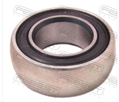
Product Specifications
| FEBEST | AS3058202RS |
The BEARING ASSY is a precision rolling element bearing used in the vehicle's drivetrain — gearbox, differential, transfer case, or driveshaft intermediate support — to support rotating shafts under combined radial and axial loads while maintaining precise shaft alignment, minimising friction losses in the power transmission circuit, and containing the drivetrain lubricant within the housing. Drivetrain bearings appear in multiple configurations depending on their load and speed requirements: deep-groove ball bearings support the input, layshaft, and output shafts of manual gearboxes against primarily radial gear mesh loads with moderate axial loads from helical gear thrust; tapered roller bearings support the differential pinion and ring gear shafts against the large combined radial and axial loads generated by hypoid and helical gear sets, with pre-load applied by shim adjustment to control gear mesh backlash; cylindrical roller bearings carry high radial gear mesh loads on gearbox layshafts with minimal axial capacity; needle roller bearings support gear hubs on their shafts in thin-section positions where a conventional ball or roller bearing would not fit; and centre bearing assemblies — a ball bearing pressed into a rubber-isolated bracket — support the intermediate section of a two-piece propeller shaft, isolating driveshaft vibration from the body while maintaining shaft alignment. All drivetrain bearing types share the requirement for continuous oil bath lubrication — either from the housing's oil level that the bearing runs partially submerged in, or from directed oil jets in pressurised gearbox systems — and all are designed for indefinite service life under normal operating conditions when the drivetrain fluid is maintained at the correct level and changed at the OEM interval.
This unit — FEBEST AS3058202RS — is manufactured to OEM-equivalent specifications: bearing bore and outer diameter, width, dynamic and static load rating, internal clearance class, cage material, rolling element type and count, and seal or shield configuration are matched to the original part. Supplied as a complete bearing assembly ready for press-fit installation. Available wholesale from 3.9 USD, MOQ 300 pcs, production lead time 20-55 days.
Drivetrain bearings fail through rolling element and raceway fatigue spalling after high mileage — a process accelerated by inadequate lubrication from low fluid level, contaminated or degraded fluid, or extended service intervals that allow the lubricant's anti-wear additive package to deplete; through false brinelling from vibration during storage or transport that creates Hertzian contact dents on the raceways before the bearing enters service; and through contamination by metallic particles from a gear failure that circulates abrasive debris through the lubricant to all bearings in the housing simultaneously. A bearing that has failed in a gearbox or differential should always prompt a drain and inspection of the lubricant for metallic debris before the housing is closed — metallic debris from a bearing failure that is not removed will destroy the replacement bearing within a short operating period.
- Drain the gearbox or differential oil and inspect for metallic debris before disassembly — drain into a clean white container and allow to settle; metallic particles visible in the settled oil or collected on the magnetic drain plug indicate that bearing or gear material has been circulating in the lubricant; the debris must be completely removed before the new bearing is installed; flush the housing with clean new oil of the correct grade and drain again before final assembly if significant contamination is found.
- Use a hydraulic press with the correct support plate and driver cup to remove and install the bearing — never drive a gearbox or differential bearing in or out with a hammer and drift; impact force concentrates on one point of the bearing outer or inner race, causing Brinell denting of the raceways before the bearing is installed; always apply force through a driver cup that contacts the full circumference of the race being driven; apply force to the outer race when pressing into a housing bore; apply force to the inner race when pressing onto a shaft.
- Inspect the housing bore and shaft journal for wear, corrosion, and out-of-round condition before installing the new bearing — a housing bore that has been enlarged by a spinning outer race will not provide the interference fit the new bearing requires; measure the bore diameter at two perpendicular orientations; any bore enlargement beyond 0.05 mm requires housing replacement or line boring before the new bearing is installed.
- On tapered roller bearings in differentials, set the preload to the OEM specification using the correct shim or nut adjustment procedure — tapered differential bearings require a specific preload that controls gear mesh backlash and bearing fatigue life; too little preload allows gear mesh noise and accelerated bearing wear; too much preload generates heat that breaks down the lubricant and causes premature bearing failure; measure rotating torque with a dial torque wrench after assembly and adjust shims until the OEM specification is achieved.
- Replace all shaft seals at the bearing's shaft exit points simultaneously with the bearing — a bearing that has been running with radial play will have worn the seal lip contact surface on the shaft; fitting a new seal on a worn shaft surface produces an immediate oil leak; always replace the shaft seal when the adjacent bearing is replaced to restore complete oil containment.
- Install the new BEARING ASSY (FEBEST AS3058202RS), reassemble the housing with all shims and preload settings confirmed, fill with fresh lubricant of the correct OEM specification and quantity, run the drivetrain through all gear positions under light load for 5 minutes to distribute the lubricant through all bearing positions, and confirm the noise is eliminated and no leaks are present before returning the vehicle to service.
| Part | Reason for Combined Replacement |
|---|---|
| Shaft Oil Seals Input, output, or pinion seal — application-specific | Every oil seal adjacent to a replaced bearing must be renewed simultaneously. A bearing that has been running with radial play creates shaft runout that wears a groove in the seal lip contact surface; a new seal on a grooved shaft produces an immediate oil leak. The shaft seal is accessible at minimal additional cost during every bearing replacement operation — always include the seal in the replacement parts order before beginning housing disassembly. |
| Gearbox or Differential Oil GL-4 or GL-5 per OEM specification and quantity | Bearing failure generates metallic debris that contaminates the entire lubricant volume in the housing. Refilling with the contaminated old oil after bearing replacement recirculates this debris through the new bearing's raceways from the first revolution, reproducing the contamination-induced wear mechanism. Always drain, flush, and refill with fresh lubricant of the correct OEM specification at every bearing replacement — the oil change is not optional. |
| Synchroniser Rings or Gear Set Application-specific to the shaft position | A gearbox bearing that has allowed shaft deflection will have subjected the adjacent gear mesh to misalignment loads that accelerate synchromesh cone wear and gear tooth flank fatigue. With the gearbox open for bearing replacement, inspect the synchromesh rings on the adjacent gears for wear beyond the service limit and the gear teeth for flank pitting or spalling; addressing any gear damage simultaneously with the bearing eliminates a repeat gearbox opening for gear-related noise within a short interval. |