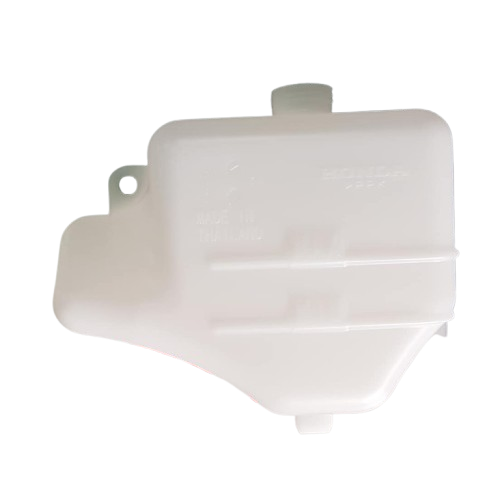
HONDA 1910155AZ00 EXPANSION TANK
Product Specifications
| HONDA | 1910155AZ00 |
The Honda 19101-55A-Z00 (also 1910155AZ00) is the Coolant Reserve Tank (Tank COMP., Reserve) for the Honda Grace 1st generation (GM6 / GM9, 2014–2020) — JDM-only Honda subcompact sedan, equivalent to export-market 6th-gen Honda City sedan, built specifically for Japan domestic market under the Grace nameplate. The reserve tank is the blow-moulded polyethylene reservoir mounted in the engine bay accommodating coolant volume changes from thermal cycling, serving as visual level inspection point. Connects to radiator overflow port + cooling circuit bleed point.
On the Honda Grace cooling system, the reserve tank operates as standard automotive coolant overflow / recovery reservoir. Connected to radiator pressure cap overflow nipple via small-bore hose. As engine warms cold-to-operating, coolant expands ~6–10% — expansion volume passes through pressure cap (lifts at ~1.0–1.4 bar) into reserve tank. On cool-down, coolant contracts and vacuum draws coolant back from tank, restoring radiator to fully filled state.
Grace reserve tank features visible MIN / MAX level marks moulded into translucent polymer wall — visual inspection without removing cap. Tank cap is low-pressure seal cap (NOT high-pressure radiator cap) — reserve tank is at atmospheric pressure during normal operation. Important distinction: removing tank cap on hot engine is safe; removing radiator cap on hot engine is dangerous (pressurised steam release).
Reserve tanks fail through polymer wall stress cracking at hose nipples, UV degradation turning translucent polymer opaque / yellow, cap thread damage from over-tightening, level sensor port leakage on equipped variants, and impact damage from minor accident events. In tropical / hot-climate operation (used JDM-imported Grace stock), UV degradation accelerates loss of visibility.
| International HS Code | 3926.90 |
| EAEU Customs Code (TN VED) | 3926 90 970 9 |
| Country of Manufacture | China |
| Quality standard | IATF 16949 |
| Hazardous goods | No |
| Packaging | Individual cardboard packaging with vehicle application label and protective polymer wrap |
Coolant reserve tanks are typically classified under HS 3926.90 (other articles of plastics) or alternatively under HS 8409.91 (parts suitable for use solely or principally with spark-ignition internal combustion piston engines) depending on jurisdiction. Confirm the exact 10-digit subheading and applicable duty rates with your customs broker. Commercial invoice description: coolant reserve tank for passenger vehicle, blow-moulded polyethylene reservoir with hose connection nipples, mounting bracket provisions, and translucent wall with level inspection marks.
| Vehicle | Years & engine variants |
|---|---|
| Honda Grace GM6 (1.5L petrol DOHC i-VTEC) | 2014–2020 — JDM 4-door subcompact sedan, FF or 4WD. Engine: L15Z1 1.5L i-VTEC 132 hp. Sold under Grace nameplate in Japan; equivalent vehicles in export markets are different references on the City platform |
| Honda Grace GM9 (1.5L Sport Hybrid i-DCD) | 2014–2020 — JDM hybrid variant. Engine: LEB 1.5L Atkinson-cycle + i-DCD dual-clutch hybrid system. The hybrid cooling system layout differs from the petrol variant in some details — verify by OEM stamped on existing reserve tank before ordering for hybrid GM9 application |
Does NOT fit: Honda City sedan export markets (any generation, GM2 / GM3 / GM5 / etc.) — despite shared platform, export-market City uses different cooling system suppliers and different reserve tank references; Honda Fit / Jazz (any generation, GE / GK / GR / GS series) — uses different reserve tank references (e.g., 19101-RB0-000 for 2009-2016 Fit / Insight / CR-Z; 19101-5R1-000 for 2015-2020 Fit GK series); Honda Civic (any generation including FC / FK / FE) — different platform with different references; Honda HR-V / Vezel / XR-V (RU / RV / RZ series) — despite shared 1.5L engine family on some variants, uses different reserve tank reference (e.g., 19101-64A-A00 for 2022+ Civic / HR-V); Honda Insight — different reserve tank reference family; Honda CR-Z — uses 19101-RB0-000 family. Always verify by reading the OEM number stamped on the existing reserve tank or in the Honda parts catalogue (yoshiparts.com / hondapartsdirect.com / megazip.net) for your specific Grace VIN.
Difficulty: Easy. Estimated time: 30–45 minutes. Allow the engine to cool fully before starting — coolant at operating temperature is approximately 90°C and at system pressure (~1.2 bar) which produces steam-burn risk if any line is disconnected hot.
- 1Park on level surface, cool engine fully — min 60 minutes after shutdown, ideally overnight. Confirm by touching upper radiator hose — should be cool to firm warmth, not hot. Open bonnet.
- 2Place coolant catch container beneath tank — min 1 L capacity. Honda Grace coolant is glycol-based (Honda Long-Life Type 2 or equivalent), toxic to animals, dispose via authorised waste collection.
- 3Disconnect the coolant level sensor electrical connector if equipped on the Grace variant being serviced. Photograph the connector orientation for refitting. Free the wiring from any clips that route along the tank body.
- 4Disconnect the coolant hoses from the tank's nipples — typically the overflow hose to the radiator and (if equipped) a bleed line from the cylinder head bleed point. Use a hose clamp release tool for spring-type clamps; for screw-type clamps, loosen with a flat-blade screwdriver. Position the catch container to capture residual coolant from the disconnected hoses and the tank.
- 5Remove the reserve tank mounting bolts or clips from its bracket on the inner wing or engine bay structure. Honda Grace typically uses 2 small bolts (8 mm head) or 1 bolt + 1 retention clip. Lift the tank up and out of its mounting position.
- 6Empty residual coolant from the old tank into the catch container. Inspect the old tank for the failure mode (crack location, hose nipple condition, cap thread integrity, level sensor seal condition) to confirm the diagnosis before installing the new tank.
- 7Compare the new tank to the old one — verify hose nipple positions match, cap thread matches, mounting bracket holes align, and level sensor port (if equipped) is in the correct position. Confirm the OEM number on the new tank reads 19101-55A-Z00.
- 8If level sensor is separately serviceable, transfer from old to new tank using new sealing O-ring (old O-ring hardened, will leak). Verify sensor port on new tank accepts existing sensor. If integral, discard old sensor.
- 9Mount the new reserve tank in its bracket and torque the mounting bolts to OEM spec (typically 8–10 Nm for M6 fasteners). Reconnect the coolant hoses to their nipples and tighten the clamps to ensure secure seal — verify by gentle pull on each hose to confirm it does not slip.
- 10Reconnect the coolant level sensor electrical connector if applicable. Refill the cooling system with the correct Honda coolant specification (Honda Long-Life Coolant Type 2 or equivalent OAT-spec ethylene-glycol coolant pre-mixed to 50:50 with deionised water, to maintain Honda's specified freeze protection and corrosion inhibitor concentration).
- 11Bleed the cooling system — with the radiator filler cap removed and engine off, fill the radiator slowly to displace air. Squeeze the upper radiator hose to encourage air migration. Top up the reserve tank to the MAX level mark.
- 12Start engine, set climate control to max heat + fan ON to open heater circuit, run 10-15 min until thermostat opens (upper radiator hose becomes hot). Watch for air bubbles in radiator + reserve tank, top up as air purges. Once stable temperature without bubbling, refit radiator cap, cool engine fully, re-check reserve tank level cold + top up to MAX if needed.
| Part | Reference | Reason for Combined Replacement |
|---|---|---|
| Radiator Pressure Cap | Honda Grace radiator pressure cap, typically 1.0–1.4 bar rating | Mandatory at cooling system service. The pressure cap on the radiator (NOT reserve tank) determines system operating pressure; sealing rubber degrades on same timescale as reserve tank polymer. Cap that doesn't hold rated pressure causes chronic coolant loss through overflow, often misdiagnosed as leaking reserve tank. Always replace simultaneously. |
| Coolant Level Sensor | Honda Grace coolant level sensor (if separate serviceable component) | If original failure included coolant low warning lamp behaving abnormally, level sensor is separate fault that may continue on new tank. Inspect sensor body + connector for corrosion / damage. Replace simultaneously if warning was unreliable. |
| Coolant Overflow / Bleed Hoses | Honda Grace cooling system small-bore hose set | Thin-walled hoses connecting tank to radiator + cylinder head bleed point degrade over time — soft / swollen / cracked / kinked hoses produce coolant loss mimicking tank failure. Inspect during replacement; replace any showing degradation. Inexpensive but commonly overlooked. |
| Honda Long-Life Coolant Type 2 | Honda OEM coolant + deionised water for 50:50 pre-mix | Mandatory complete refill at tank replacement. Old coolant has reduced inhibitor concentration + sediment contamination. Use only Honda Type 2 or equivalent OAT-spec product for Honda corrosion protection on aluminium cylinder head + engine block. |
| Hose Clamps (Spring or Screw Type) | Honda Grace cooling system hose clamp kit | Tank service requires disconnection of multiple hoses. Aged spring clamps lose tension; aged screw clamps corrode + strip during retightening. Order clamp kit alongside tank. Poorly clamped connection = coolant leak mimicking leaking new tank. |