LONGWISE LWGKB200 DRIFT TRIKE
Product Specifications
| LONGWISE | LWGKB200 |
Product Overview
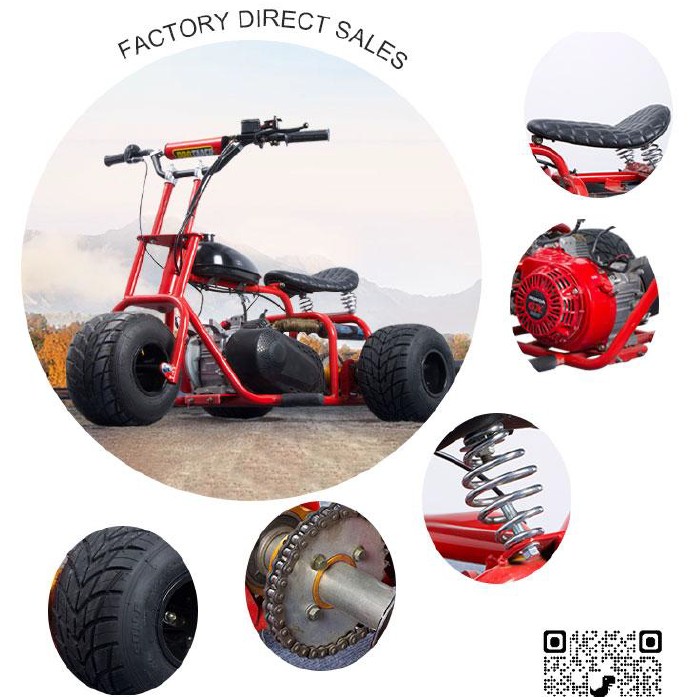
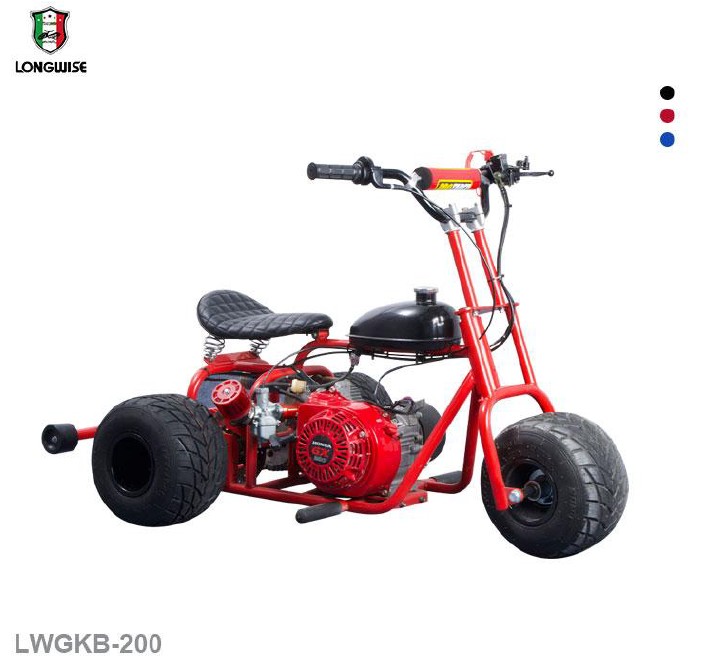
The LWGKB-200 represents a unique three-wheeled drift trike featuring a 200cc 4-stroke gasoline engine, chopper-style design, and oversized rear tires specifically engineered for controlled drifting on asphalt surfaces. Combining mini-bike aesthetics with drift trike functionality, this 137kg recreational vehicle delivers thrilling sideways driving experiences through its wide-stance configuration and hydraulic rear disc brake.
Built on a high-carbon steel frame with chain drive, pulling start system, and 11x7.10-5 inch alloy hub tires, the LWGKB-200 provides an alternative to traditional four-wheeled drift karts. The three-wheel layout with single front wheel and dual rear wheels creates a stable platform optimized for intentional rear-end sliding while maintaining directional control through the front steering.
Core Specifications
Detailed Technical Specifications
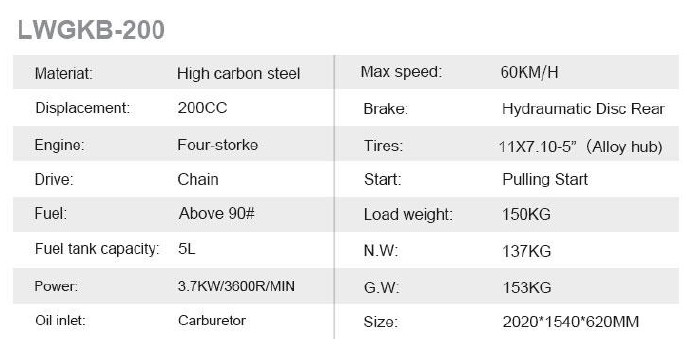
| Component | Specification | Details |
|---|---|---|
| Frame Material | High Carbon Steel | Welded tubular construction with chopper styling |
| Vehicle Configuration | Three-Wheel Drift Trike | One front wheel, two rear wheels |
| Engine Displacement | 200cc | Single-cylinder 4-stroke gasoline |
| Engine Type | 4-Stroke | Air-cooled OHV configuration |
| Power Output | 3.7 kW @ 3600 RPM | Approximately 5.0 horsepower |
| Fuel System | Carburetor | Traditional carburetor with manual choke |
| Oil Inlet | Carburetor | Fuel mixing via carburetor (oil separate in 4-stroke) |
| Fuel Type | Gasoline Above 90 Octane | Regular unleaded 90+ octane recommended |
| Fuel Tank Capacity | 5 liters | Extended runtime for drift sessions |
| Starting System | Pull Start | Recoil pull-cord starter |
| Drive System | Chain Drive | Chain-driven rear axle |
| Brake System | Hydraulic Disc Rear | Rear hydraulic disc brake only |
| Tire Size | 11 x 7.10-5 inch | Large low-profile tires with alloy hubs |
| Wheel Type | Alloy Hub | Lightweight alloy wheels |
| Maximum Speed | 60 km/h | Top speed on flat asphalt |
| Maximum Load | 150 kg | Rider weight capacity |
| Net Weight | 137 kg | Vehicle dry weight |
| Gross Weight | 153 kg | Shipping weight with packaging |
| Overall Size | 2020 x 1540 x 620 mm | Length x Width x Height |
What is a Drift Trike?
A drift trike is a three-wheeled vehicle specifically designed for controlled sliding (drifting) on paved surfaces. Unlike traditional trikes built for traction, drift trikes intentionally use low-grip rear tires or hard plastic sleeves to enable the rear end to break traction and slide sideways through corners while the front wheel maintains steering control.
LWGKB-200 Design Philosophy
The LWGKB-200 combines drift trike functionality with mini-chopper aesthetics, creating a unique recreational vehicle that delivers drifting thrills with motorcycle-inspired styling.
- Wide Stance: 1540mm width provides stability during sideways sliding
- Low Seat Height: 620mm overall height keeps center of gravity low for control
- Chopper Styling: Extended front fork and low-slung design mimics custom motorcycle aesthetics
- Rear-Wheel Drift: Dual rear wheels with low-grip characteristics enable controlled slides
Performance Characteristics
200cc Engine Power
The 3.7kW (5 HP) output from 200cc displacement provides adequate power for drift trike applications where momentum and technique matter more than raw horsepower.
| Metric | Performance |
|---|---|
| Acceleration | Moderate - 0-40 km/h in approximately 6-10 seconds |
| Top Speed | 60 km/h on flat asphalt |
| Drift Initiation | Requires throttle control and weight transfer techniques |
| Fuel Economy | Approximately 5-7 L/100km |
| Range per Tank | 70-100 km per 5L tank |
Applications
Primary Use Cases
- Drift Trike Parks: Commercial facilities offering motorized drift trike experiences
- Parking Lot Drifting: Controlled drifting in empty paved lots (with permission)
- Track Day Events: Drift trike competitions and recreational events
- Stunt Shows: Professional demonstrations and exhibitions
- Private Recreation: Hobbyists with access to private paved areas
Rider Profile
Height: 155-185 cm for comfortable reach to controls
Weight: Maximum 150 kg
Experience: Motorcycle or drift kart experience highly recommended
Skills: Understanding of throttle control, weight transfer, counter-steering
Protective gear MANDATORY: Full-face helmet, leather jacket, gloves, boots
Knee and elbow pads STRONGLY recommended
Rear-only brake requires advanced braking technique
Operate only on smooth asphalt away from traffic and pedestrians
High skill requirement - drifting is inherently risky
Adult supervision recommended for riders under 18
Starting and Basic Operation
Starting Procedure
- Ensure fuel valve is ON
- Set choke to FULL (cold start)
- Sit on trike with feet on ground for stability
- Pull recoil starter cord briskly 2-5 times
- Once started, gradually close choke as engine warms
- Allow 2-3 minute warm-up before riding
Drifting Technique Basics
Entry: Approach corner with moderate speed (20-40 km/h depending on radius)
Initiation: Turn front wheel into corner while applying throttle to break rear traction
Maintenance: Modulate throttle to control drift angle - more throttle widens drift, less throttle tightens
Exit: Straighten front wheel while reducing throttle to regain forward traction
Maintenance Schedule
| Interval | Service Tasks |
|---|---|
| Every 10 hours | Check oil level | Inspect chain tension | Check tire condition |
| Every 20-25 hours | Change engine oil | Lubricate chain | Inspect brake pads |
| Every 50 hours | Replace air filter | New spark plug | Adjust valve clearance |
| Every 100 hours | Deep service | Carburetor cleaning | Chain/sprocket replacement |
Troubleshooting
| Problem | Solution |
|---|---|
| Won't start | Check fuel | Clean spark plug | Adjust choke |
| Rear won't drift | Check tire pressure (lower for more drift) | Adjust weight distribution |
| Unstable drifting | Practice throttle control | Check tire wear | Adjust riding technique |
| Poor braking | Inspect brake pads | Bleed hydraulic system | Adjust technique (rear-only brake) |
Wholesale Information
Frequently Asked Questions
Q: Is this suitable for beginners?
Not recommended for complete beginners. Requires: prior motorcycle or drift kart experience, understanding of throttle/brake control, comfort with sideways motion. Rear-only brake demands advanced technique. Start on four-wheel drift karts before progressing to three-wheel drift trikes.
Q: Can it be used on public roads?
NO - not street legal. Lacks headlights, taillights, turn signals, mirrors. Designed exclusively for closed courses, private property, drift trike parks. Public road use = illegal and dangerous.
Q: How does three-wheel compare to four-wheel drift vehicles?
Three-wheel advantages: More exciting/challenging, unique experience, easier to initiate drifts. Disadvantages: Less stable, higher skill requirement, rear-only brake more difficult. Four-wheel drift karts: More stable, easier to learn, better for beginners.
Q: What maintenance does it need?
Similar to small motorcycle: oil changes every 20-25 hours, chain lubrication every 10 hours, air filter and spark plug every 50 hours. Annual cost approximately $200-350 for parts and fluids with regular use.
Q: Is it street legal?
NO. Not designed for or legal on public roads. Operate only on private property or designated closed courses.