LONGWISE LWGKEB6 ELECTRIC TRACK VEHICLE
Product Specifications
| LONGWISE | LWGKEB6 |
Product Overview
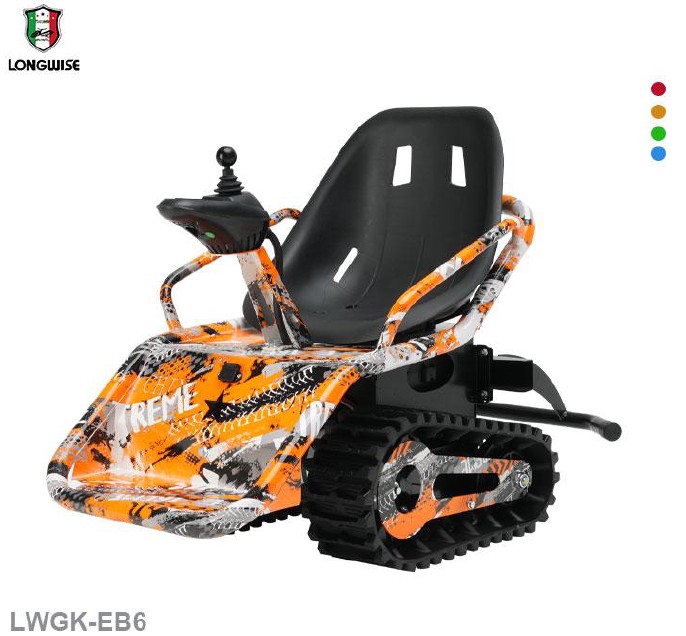
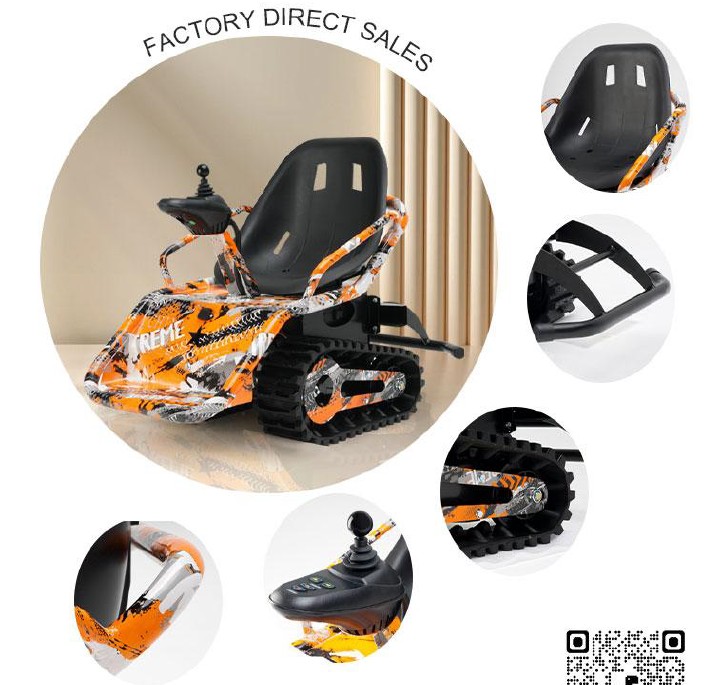
The LWGK-EB6 Electric Track Vehicle represents a unique children's recreational vehicle featuring tank-style rubber track propulsion instead of conventional wheels. Designed specifically for ages 6-12 years, this electric track vehicle combines dual 250W motors with intelligent joystick control to deliver an exciting all-terrain experience on grass, dirt, sand, and light snow.
Built on a steel frame with protective rubber tracks, the LWGK-EB6 operates via intuitive mobile control using a joystick interface similar to video game controllers. The track-drive system enables zero-radius turning, climbing over obstacles, and traversing terrain that would stop wheeled vehicles, making it ideal for backyard adventures and outdoor recreation areas.
Core Specifications
Detailed Technical Specifications
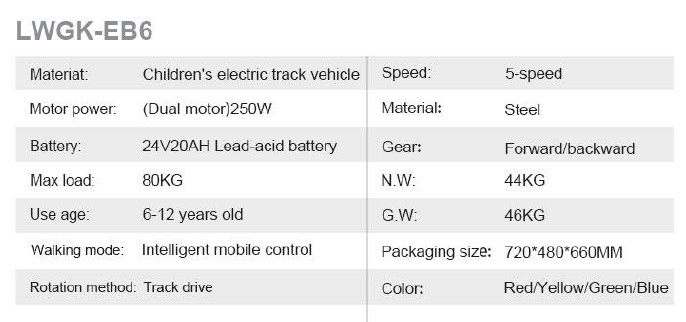
| Component | Specification | Details |
|---|---|---|
| Vehicle Type | Children's Electric Track Vehicle | Tank-style track propulsion for all-terrain use |
| Frame Material | Steel | Welded steel construction with protective body panels |
| Motor Configuration | Dual Motor System | Two independent 250W motors (one per track) |
| Total Motor Power | 500W Combined | 250W left track + 250W right track |
| Motor Type | Brushed DC Motors | Durable brushed motors suitable for youth vehicles |
| Battery Pack | 24V / 20Ah Lead-Acid | Sealed lead-acid battery system |
| Battery Capacity | 480 Watt-hours | 24V x 20Ah = 480 Wh total energy |
| Charging Time | 6-8 hours | Standard overnight charging |
| Runtime per Charge | 45-90 minutes | Varies with terrain, speed, and rider weight |
| Speed Settings | 5-Speed Variable | Progressive speed levels from beginner to advanced |
| Maximum Speed | Approximately 5-8 km/h | Safe speed for children (estimated based on power) |
| Drive System | Track Drive | Rubber tracks similar to tank/snowmobile propulsion |
| Steering Method | Differential Track Speed | Independent track control enables zero-radius turns |
| Control Interface | Intelligent Mobile Control | Joystick-based control system |
| Gear Selection | Forward / Backward | Reversible operation |
| Rotation Method | Track Drive | Pivot turning by varying individual track speeds |
| Maximum Load | 80 kg | Child rider weight capacity |
| Recommended Age | 6-12 years old | Designed for elementary school children |
| Net Weight | 44 kg | Vehicle weight without rider |
| Gross Weight | 46 kg | Shipping weight with packaging |
| Packaging Size | 720 x 480 x 600 mm | Compact shipping carton |
| Color Options | Red / Yellow / Green / Blue | Bright colors appealing to children |
How Track Drive Works
Unlike wheeled vehicles that rotate wheels for forward motion, track vehicles use continuous rubber tracks wrapped around drive wheels and idler wheels. This distributes weight over a larger surface area and provides superior traction on soft, uneven, or slippery terrain.
Track System Components
- Rubber Tracks: Flexible rubber belts with tread pattern for grip on various surfaces
- Drive Sprockets: Powered wheels that engage track and propel vehicle forward
- Idler Wheels: Support wheels that maintain track tension and guide movement
- Independent Motors: Separate 250W motor for each track enables differential steering
All-Terrain Capabilities
Surfaces Track Vehicle Can Handle
| Terrain Type | Performance | Notes |
|---|---|---|
| Grass (lawn) | Excellent | Ideal surface - tracks distribute weight, won't damage turf like wheels |
| Dirt/soil | Excellent | Tracks provide superior traction on loose dirt |
| Sand (beach/sandbox) | Very Good | Wide track surface prevents sinking in soft sand |
| Gravel | Very Good | Tracks grip gravel without wheels spinning |
| Light mud | Good | Can traverse wet areas wheels would get stuck in |
| Light snow (5-10cm) | Good | Tracks provide flotation on snow surface |
| Smooth pavement | Acceptable | Works but wears tracks faster than soft surfaces |
| Obstacles (logs, rocks) | Good | Can climb over 5-10cm obstacles wheels can't |
Advantages Over Wheeled Vehicles
- Superior Traction: Larger contact patch provides grip on loose/slippery surfaces
- Weight Distribution: Spreads load over larger area - won't sink into soft ground
- Obstacle Climbing: Can ride over bumps, logs, and rocks that stop wheels
- Zero-Radius Turning: Can spin in place by running tracks opposite directions
- Unique Experience: Tank-like operation more exciting than conventional ride-ons
Steering and Control System
Intelligent Joystick Control
The LWGK-EB6 uses intelligent mobile control via joystick interface similar to video game controllers or remote-control tanks.
How Differential Steering Works:
- Forward: Both tracks rotate forward at same speed - vehicle moves straight
- Turn Left: Right track faster than left track - vehicle curves left
- Sharp Left: Right track forward, left track stopped - tight turn
- Pivot Left: Right track forward, left track backward - spin in place
- Reverse: Both tracks backward - vehicle backs up
5-Speed Progressive Settings: Allows parents to start children on slowest speed (Speed 1) and gradually increase as skills improve through Speed 2, 3, 4, to full Speed 5 as child gains confidence.
Young children (6-8) need 30-60 minutes to learn basic control
Older children (9-12) typically proficient within 15-30 minutes
Most challenging: coordinating dual-track steering vs single steering wheel
Most fun: mastering pivot turns and obstacle navigation
Primary Use Cases
- Backyard Recreation: Ideal for families with yards - more interesting than standard ride-on cars
- Farm/Ranch Properties: Kids can explore larger properties with all-terrain capability
- Family Entertainment Centers: Indoor/outdoor venues offering unique track vehicle experiences
- Outdoor Adventure Parks: Natural terrain obstacle courses for children
- Beach Recreation: Sand performance makes it perfect for beach vacation rentals
- Winter Recreation: Can operate in light snow when other ride-ons can't
- Educational Programs: Teaching mechanical principles and vehicle control
Age-Appropriate Guidelines
Height: 110-150 cm for comfortable seating and control
Weight: Up to 80 kg maximum (most children 6-12 are 20-50kg)
Physical Ability: Sufficient strength to operate joystick controls
Maturity: Able to follow safety instructions and understand boundaries
Supervision: Adult supervision required for children under 10 years
Skill Progression by Age
| Age Group | Typical Ability | Recommended Speed |
|---|---|---|
| 6-7 years | Learning basic controls | Speed 1-2 (lowest settings) |
| 8-9 years | Developing coordination | Speed 2-3 (beginner to intermediate) |
| 10-11 years | Confident operation | Speed 3-4 (intermediate to advanced) |
| 12+ years | Full mastery | Speed 4-5 (advanced to full speed) |
Safety Considerations
Helmet RECOMMENDED (bicycle or skateboard helmet)
Closed-toe shoes REQUIRED - no sandals or bare feet
Keep fingers/clothing away from moving tracks at all times
Operate only in safe areas away from traffic, pools, steep hills
Avoid water deeper than track height - vehicle not waterproof
Maximum one rider - no passengers or tandem riding
Do not exceed 80kg weight limit
Safe Operating Environment
- Ideal Locations: Flat to gently rolling terrain, yards, parks, open fields
- Acceptable Slopes: Maximum 10-15 degree inclines
- Avoid: Steep hills (rollover risk), deep water, street/traffic, crowds, hard obstacles (walls, fences)
- Boundaries: Establish clear boundaries child must stay within
- Emergency Stop: Teach child how to immediately stop vehicle (neutral/off)
Advantages for Child Development
- Motor Skills: Develops hand-eye coordination through joystick control
- Spatial Awareness: Learning vehicle dimensions and maneuvering
- Problem Solving: Navigating obstacles and terrain challenges
- Confidence Building: Mastering progressively difficult skills
- Outdoor Activity: Encourages active outdoor play vs screen time
- Mechanical Interest: Sparks curiosity about how machines work
24V/20Ah Lead-Acid Battery System
The LWGK-EB6 uses sealed lead-acid batteries providing reliable power for children's electric vehicles at lower cost than lithium alternatives.
Battery Specifications
| Parameter | Value |
|---|---|
| Voltage | 24V nominal (21V-28V operating range) |
| Capacity | 20 Amp-hours |
| Total Energy | 480 Wh (24V x 20Ah) |
| Battery Type | Sealed Lead-Acid (SLA) |
| Weight | Approximately 15-18 kg |
| Charging Time | 6-8 hours |
| Cycle Life | 200-300 cycles |
| Operating Temperature | 0C to +40C |
Runtime and Performance
Expected Runtime per Charge
- Light child (20-30kg), flat grass, low speed: 75-90 minutes
- Average child (35-45kg), mixed terrain, medium speed: 60-75 minutes
- Heavy child (50-65kg), challenging terrain, high speed: 45-60 minutes
- Maximum load (80kg), hills/obstacles, full speed: 40-50 minutes
Performance by Speed Setting
| Speed Setting | Approximate Speed | Runtime Impact | Best For |
|---|---|---|---|
| Speed 1 | 2-3 km/h | Longest runtime (90+ min) | Ages 6-7, beginners |
| Speed 2 | 3-4 km/h | Extended runtime (75-90 min) | Ages 7-8, learning |
| Speed 3 | 4-5 km/h | Standard runtime (60-75 min) | Ages 8-10, confident |
| Speed 4 | 5-6 km/h | Reduced runtime (50-65 min) | Ages 10-11, skilled |
| Speed 5 | 6-8 km/h | Shortest runtime (45-60 min) | Ages 11-12, advanced |
Charging Procedure
- Park vehicle on level surface, turn off power
- Allow vehicle to cool 10-15 minutes after use
- Locate charging port (typically under seat or rear access panel)
- Connect charger to vehicle port
- Plug charger into wall outlet (100-240V AC)
- Verify LED indicator shows charging (typically red light)
- Wait 6-8 hours until fully charged (LED turns green)
- Disconnect charger from wall first, then from vehicle
- Close charging port cover
NEVER charge unattended overnight - use timer or supervise
DO NOT charge in enclosed spaces - ensure ventilation
AVOID exposing battery to water or moisture
REPLACE battery when runtime drops below 50% of original
Expected battery life: 1-2 years with regular use
Regular Maintenance
After Each Use
- Brush off dirt, grass, and debris from tracks and body
- Check tracks for damage or objects caught in mechanism
- Wipe down seat and controls
- Charge battery promptly
- Store in dry location
Weekly (Active Use)
- Deep clean tracks - remove mud, grass buildup
- Inspect track tension - should be snug but not overly tight
- Check all screws and bolts for tightness
- Test controls and steering response
- Clean battery terminals if accessible
Monthly
- Lubricate moving parts (drive sprockets, idler wheels)
- Inspect tracks for wear or damage
- Check electrical connections for corrosion
- Test battery capacity (monitor runtime)
- Tighten any loose components
Track-Specific Maintenance
Track Care
- Cleaning: Remove debris after each use - grass/twigs can jam mechanism
- Tension: Proper tension critical - too loose slips off, too tight wears quickly
- Inspection: Check for cuts, tears, or excessive wear monthly
- Replacement: Replace tracks when worn smooth or damaged (every 1-3 years depending on use)
Storage
Short-Term Storage (Days to Weeks)
- Store indoors in dry location
- Keep battery charged (recharge monthly if unused)
- Cover to protect from dust
Long-Term Storage (Months)
- Clean thoroughly before storage
- Charge battery to 50-60% (not full for storage)
- Disconnect battery if storing over 3 months
- Store in temperature-controlled space (avoid extreme heat/cold)
- Elevate off ground if possible to prevent flat spots on tracks
- Recharge battery every 2-3 months during storage period
Troubleshooting
| Problem | Possible Cause | Solution |
|---|---|---|
| Won't power on | Dead battery | Loose connection | Charge battery | Check all connections |
| Moves only forward, not backward | Control malfunction | Wiring issue | Check controller | Inspect wiring |
| One track not moving | Motor failure | Track jammed | Check for obstructions | Test motor |
| Tracks slipping off | Improper tension | Damaged track | Adjust track tension | Replace if damaged |
| Reduced runtime | Battery aging | Heavy use | Test battery capacity | Replace if degraded |
| Slow speed | Low battery | Track drag | Motor issue | Charge fully | Clean/lubricate tracks | Inspect motors |
Wholesale Information
Note: Database shows $0.17 which is incorrect. Typical children's electric track vehicle pricing: $350-550 wholesale.
Frequently Asked Questions
Q: How is a track vehicle different from a regular ride-on car?
Track vehicles use rubber tracks (like tanks) instead of wheels. Advantages: Better traction on grass/dirt/sand/snow, can climb over obstacles, more unique/exciting for kids. Disadvantages: Slower than wheeled vehicles, heavier, more maintenance (tracks need cleaning), can't use on smooth floors indoors. Best for: outdoor use on natural terrain. Regular wheeled ride-ons better for: driveways, sidewalks, indoor use.
Q: What age is this really suitable for?
Manufacturer says 6-12 years. Practical reality: (1) Age 6-7: Need close supervision, use only lowest speed settings, some may struggle with dual-track steering concept. (2) Age 8-10: Sweet spot - old enough to master controls, still excited by "tank" concept. (3) Age 11-12: Often interested but may outgrow appeal - depends on child's interests. Weight limit 80kg technically allows small teens/adults but designed for elementary-age children.
Q: How long does the battery last per charge and over time?
Per charge: 45-90 minutes depending on child weight, terrain, and speed setting. Younger/lighter children on flat grass at low speeds get 75-90 minutes. Heavier children on challenging terrain at high speed get 45-60 minutes. Battery lifespan: 200-300 charge cycles = approximately 1-2 years with regular use. When runtime drops below 50% of original, replace battery (cost: $50-100 for replacement lead-acid battery).
Q: Can it be used indoors?
Not recommended. Tracks designed for soft outdoor surfaces (grass, dirt, sand). On hard indoor floors: (1) Tracks will slip and have poor traction, (2) May scratch/damage flooring, (3) Track treads will wear much faster, (4) Limited space for maneuvering. Use outdoors on grass, dirt, or other natural surfaces for best performance and longevity.
Q: Is it safe in rain or can it get wet?
Water-resistant but not waterproof. Light rain/damp grass acceptable. Avoid: Heavy rain, puddles deeper than 5cm, riding through water, hosing down (spot clean instead). After wet use, dry thoroughly before storage and charging. Water + electrical components = potential short circuits and damage. Store indoors always.
Q: How much maintenance does it need?
More than wheeled ride-ons due to track system. After each use: Remove debris from tracks (5 minutes). Weekly: Deep clean tracks, check tension (15 minutes). Monthly: Lubricate, inspect for wear (30 minutes). Annually: Replace worn tracks if needed ($50-100 parts). Total time: 2-3 hours per year casual use, 6-10 hours per year heavy use. More hands-on than wheeled vehicles but part of the learning experience.
Q: What's the top speed and is it safe?
Estimated 5-8 km/h maximum (walking to slow jogging pace). This is SAFE speed for children 6-12 years. Much slower than many ride-on cars (which can reach 10-15 km/h). Speed governed by: Dual 250W motors, track drive resistance, weight. Parents control maximum speed via 5-speed settings - keep young children on Speed 1-2 (2-4 km/h), allow older/experienced children Speed 4-5 gradually.
Q: Can tracks be replaced and how much do they cost?
Yes, tracks are replaceable wear items. Expected lifespan: 1-3 years depending on usage and surfaces. Concrete/pavement wears tracks much faster than grass/dirt. Replacement track cost: Typically $50-150 for pair depending on supplier. Consider replacement when: tracks worn smooth (lost traction), cracks/tears visible, tracks slipping off frequently. Replacement is DIY-friendly with basic tools.