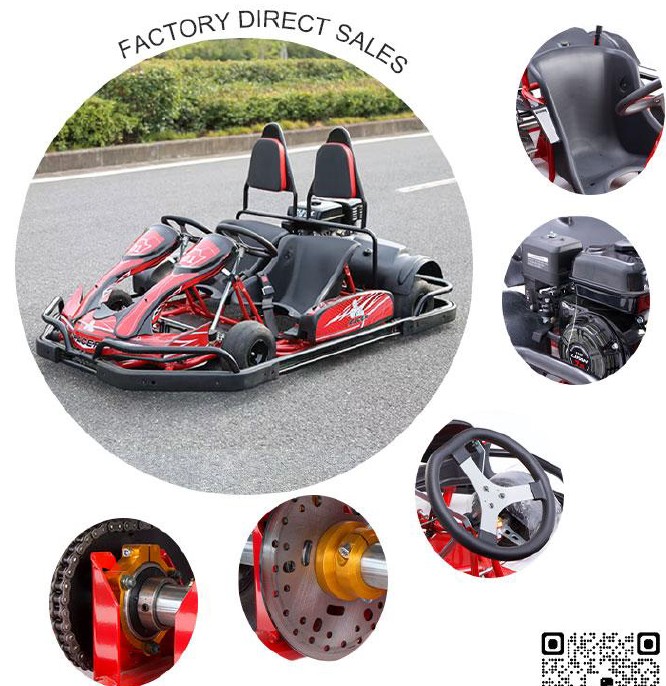
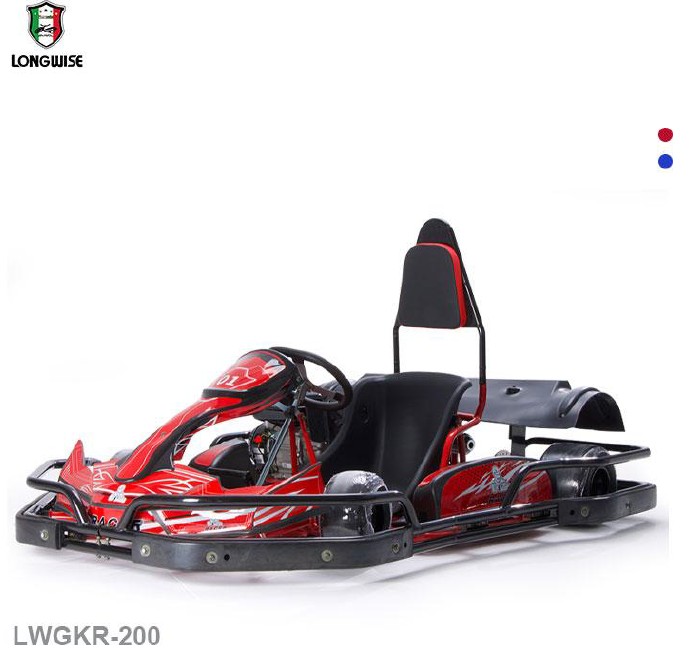
LONGWISE LWGKR2002 DRIFT KART (2-SEATED)
Product Specifications
| LONGWISE | LWGKR2002 |
Product Overview
The LWGKR-200 Double Seat Drift Kart represents a professional-grade asphalt drift karting experience designed for two riders. Built on a high-carbon steel tubular frame with a powerful 212-270cc 4-stroke engine, dry clutch transmission, and hydraulic disc brakes, this drift kart delivers authentic motorsport thrills on paved surfaces.
Specifically engineered for controlled drift performance on asphalt karting tracks, parking lots, and smooth paved areas, the LWGKR-200 features low-profile 5-inch racing slick tires, precision steering geometry, and a rigid chassis that enables exciting sideways driving. The double-seat configuration allows tandem riding for instructor/student training or shared recreational experiences.
Core Specifications
Detailed Technical Specifications
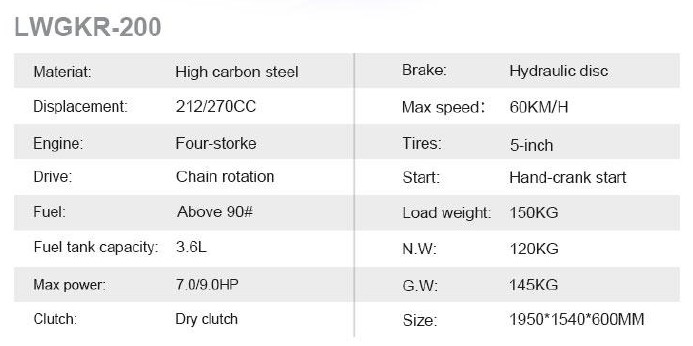
| Component | Specification | Details |
|---|---|---|
| Frame Material | High Carbon Steel | Tubular racing frame with roll cage for safety |
| Engine Displacement | 212cc or 270cc | Two engine options: 212cc (7HP) or 270cc (9HP) |
| Engine Type | 4-Stroke Gasoline | Air-cooled single-cylinder horizontal shaft engine |
| Power Output | 7.0 or 9.0 HP | 212cc = 7HP | 270cc = 9HP |
| Starting System | Hand-Crank Start | Manual pull-start mechanism (no electric starter) |
| Fuel Type | Gasoline 90+ octane | Regular unleaded gasoline (minimum 90 octane recommended) |
| Fuel Tank Capacity | 3.6 liters | Approximately 60-90 minutes continuous runtime |
| Transmission | Manual Dry Clutch | Centrifugal dry clutch with chain reduction |
| Clutch Type | Dry Clutch | Automatic engagement at specific RPM, no manual lever |
| Drive System | Chain Rotation | Chain-driven rear axle with solid axle configuration |
| Brake System | Hydraulic Disc Brakes | Rear hydraulic disc brake for controlled stopping |
| Tire Specification | 5-inch Racing Tires | Low-profile drift/racing slicks designed for asphalt |
| Maximum Speed | 60 km/h | Top speed on flat asphalt with single rider |
| Maximum Load Weight | 150 kg | Combined weight of both riders |
| Net Weight | 120 kg | Kart weight without fuel or riders |
| Gross Weight | 145 kg | Shipping weight with packaging |
| Overall Dimensions | 1950 x 1540 x 600 mm | Length x Width x Height |
| Wheelbase | Approximately 1300mm | Distance between front and rear axles |
| Track Width | Approximately 1300mm | Wide stance for stability during drifting |
| Ground Clearance | 50-70mm | Very low for minimal body roll and maximum grip |
| Seating Capacity | 2 persons | Driver plus one passenger side-by-side |
Drift Karting Experience
The LWGKR-200 is purpose-built for controlled drift driving on asphalt surfaces. Unlike off-road ATVs designed for traction, drift karts intentionally use low-grip tires and rear-wheel drive to enable sideways sliding through corners - the essence of drifting motorsport.
Primary Use Cases
- Drift Karting Tracks: Commercial drift karting facilities offering controlled drift experiences to paying customers
- Motorsport Training: Teaching drift techniques and car control skills in safe, low-speed environment
- Amusement Parks: Unique attraction for theme parks and entertainment venues with paved areas
- Corporate Events: Team-building activities and corporate entertainment experiences
- Racing Schools: Entry-level drift instruction for students learning motorsport techniques
- Private Racing Enthusiasts: Hobby drifters with private paved areas or track access
Double Seat Advantages
- Instruction: Instructor rides with student to provide real-time coaching during drift sessions
- Shared Experience: Parents can ride with children, partners can experience together
- Passenger Rides: Revenue opportunity - sell passenger rides alongside driver experiences
- Safety Oversight: Experienced operator can supervise inexperienced driver
Rider Profile
Passenger Age: 12+ years (must be able to hold on safely)
Height: 150-190 cm for comfortable seating and control reach
Weight Limit: 150 kg combined driver plus passenger
Experience: Previous karting or driving experience highly recommended
Licensing: May require special permits or waivers depending on venue
Skill Requirements
Beginner Level: Can operate the kart with instruction, but drift control difficult. Recommend starting with slow speeds, learning throttle control and steering inputs before attempting aggressive drifts.
Intermediate Level: Understands drift initiation techniques (weight transfer, throttle steering, clutch kicks). Can maintain controlled drifts through multiple corners.
Advanced Level: Masters transitions between drifts, links multiple corners, understands racing lines while drifting. Pushes limits safely within track boundaries.
Operational Environment
Suitable Surfaces
- Asphalt Karting Tracks: Ideal - smooth asphalt provides consistent drift characteristics
- Parking Lots: Large empty paved lots work well (ensure permission and safety barriers)
- Concrete Pads: Smooth concrete acceptable but may wear tires faster than asphalt
- Drift Pads: Purpose-built concrete drift pads at motorsport facilities
Unsuitable Surfaces
- Dirt, gravel, or off-road terrain - damages low-profile tires
- Grass or mud - kart gets stuck, tires clog with debris
- Rough or broken pavement - damages suspension and tires
- Public roads - NOT street legal in most jurisdictions
NEVER operate on public roads - NOT street legal
Requires dedicated track or private property with safety barriers
Protective gear MANDATORY: Full-face helmet, gloves, long sleeves/pants, closed-toe shoes
Pre-ride safety briefing essential for all operators
Medical supervision recommended for commercial operations
Insurance and liability waivers critical for rental/commercial use
Engine Options
The LWGKR-200 is available with two engine configurations, allowing operators to choose between economy/beginner-friendly 212cc or higher-performance 270cc.
212cc Configuration (7 HP)
| Parameter | Specification |
|---|---|
| Displacement | 212cc (approximately 13 cubic inches) |
| Power Output | 7.0 HP at ~3600 RPM |
| Torque | Approximately 12-14 Nm |
| Engine Type | OHV (overhead valve) 4-stroke |
| Cooling | Air-cooled with forced air fan |
| Fuel Consumption | Approximately 2.5-3 L/hour at full throttle |
| Best For | Beginner drivers, lower operating costs, longer engine life |
270cc Configuration (9 HP)
| Parameter | Specification |
|---|---|
| Displacement | 270cc (approximately 16.5 cubic inches) |
| Power Output | 9.0 HP at ~3600 RPM |
| Torque | Approximately 15-17 Nm |
| Engine Type | OHV 4-stroke horizontal shaft |
| Cooling | Air-cooled with forced air fan |
| Fuel Consumption | Approximately 3-3.5 L/hour at full throttle |
| Best For | Experienced drivers, commercial operations, better acceleration |
Performance Characteristics
Acceleration and Speed
212cc Engine: 0-50 km/h in approximately 6-8 seconds with single rider. Top speed 55-60 km/h on flat asphalt. Adequate for drift karting but less aggressive power delivery.
270cc Engine: 0-50 km/h in approximately 4-6 seconds with single rider. Top speed 60+ km/h. More aggressive acceleration makes drift initiation easier for experienced drivers.
Double-Seat Impact: With two riders (combined 150kg), expect 20-30% reduction in acceleration and 5-10 km/h lower top speed compared to single-rider performance.
Drift Performance
The LWGKR-200's drift capabilities depend on several factors:
- Tire Compound: 5-inch racing slicks provide controlled low-grip for predictable drifting
- Weight Distribution: Rear-engine, rear-drive layout concentrates weight over drive wheels
- Power Delivery: Enough power to break traction but not so much that control is impossible
- Chassis Rigidity: Stiff frame maintains predictable handling during sideways driving
Initiation: Apply throttle to break rear traction, kart begins sliding sideways
Maintenance: Modulate throttle and counter-steer to control drift angle
Exit: Straighten steering, reduce throttle smoothly to regain forward traction
Practice required: Mastering drift control takes 5-10 hours of seat time for most drivers
Fuel System
Fuel Requirements
- Fuel Type: Unleaded gasoline 90+ octane (regular unleaded acceptable, premium recommended for 270cc)
- Tank Capacity: 3.6 liters provides 60-90 minutes continuous operation
- Fuel Consumption: 2.5-3.5 L/hour depending on engine and riding intensity
- Range: Approximately 40-60km per tank (track dependent)
Starting Procedure
- Ensure fuel valve is ON position
- Set throttle to approximately 1/3 position
- Pull choke lever to FULL (cold start only)
- Grasp hand-crank start cord firmly
- Pull cord briskly - engine should start within 2-3 pulls
- Gradually reduce choke as engine warms (30-60 seconds)
- Allow 2-3 minutes warm-up before driving
Pre-Session Inspection
| Item | Check | Action |
|---|---|---|
| Fuel Level | Visual check in tank | Refuel if below 1/4 tank |
| Engine Oil | Dipstick at FULL mark | Add SAE 10W-30 if low |
| Tire Pressure | All four tires firm and equal | Inflate to spec (varies by tire type) |
| Brake Function | Press brake pedal - firm feel | Bleed if spongy, adjust if needed |
| Chain Tension | 15-20mm deflection mid-span | Adjust if too loose or tight |
| Steering | Turn wheel full lock both directions | Should be smooth, no binding |
| Frame Bolts | Visual check critical fasteners | Tighten any loose bolts |
| Safety Equipment | Seat belts functional, roll cage intact | Replace damaged components |
Maintenance Schedule
Commercial Operation Schedule (Daily Use)
| Interval | Service Tasks |
|---|---|
| Every Day | Pre-session inspection | Check oil level | Clean air filter if dusty | Lubricate chain |
| Every 20 Hours | Change engine oil | Clean/re-oil air filter | Adjust chain tension | Check tire wear |
| Every 50 Hours | Replace spark plug | Inspect brake pads | Check all bolts to torque spec | Grease bearings |
| Every 100 Hours | Deep engine service | Replace air filter | Clean carburetor | Replace chain/sprockets | Valve clearance check |
Recreational Use Schedule (Occasional Use)
| Interval | Tasks |
|---|---|
| Before Each Session | Pre-session inspection checklist |
| Every 10 Hours | Change oil | Lube chain | Check brakes |
| Seasonally | Full service including spark plug, air filter, carb clean |
| Storage (Winter) | Drain fuel, fog engine, cover kart, store in dry location |
Chain stretch occurs faster with aggressive throttle inputs - check tension weekly
Brake pads wear quickly from repeated hard braking - replace at 3mm thickness
Frame welds endure high stress - inspect for cracks monthly
Engine oil degrades faster at sustained high RPM - change every 20 hours maximum
Troubleshooting
| Problem | Cause | Solution |
|---|---|---|
| Engine won't start | No fuel | Fouled plug | Choke position | Refuel | Replace plug | Adjust choke |
| Engine dies under load | Dirty carburetor | Clogged fuel filter | Clean carb jets | Replace fuel filter |
| Clutch slipping | Worn clutch pads | Oil contamination | Replace clutch | Clean with brake cleaner |
| Poor acceleration | Clutch adjustment | Air filter blocked | Adjust clutch spring | Clean/replace filter |
| Kart pulls to one side | Unequal tire pressure | Bent axle | Equalize pressure | Inspect/replace axle |
Wholesale Pricing
Note: Database shows $0.17 which is incorrect. Typical drift kart wholesale pricing: $1200-1600 depending on engine and features.
Volume Pricing
| Quantity | Discount | Best For |
|---|---|---|
| 3-5 units | List price | Private buyers, small tracks |
| 6-10 units | 8-12% off | Karting facilities, amusement parks |
| 11-20 units | 12-18% off | Multi-location operations |
| 21-50 units | 18-25% off | Large karting chains, distributors |
| 50+ units | 25-35%+ off | Theme parks, fleet operators |
Customization
- Engine Choice: 212cc or 270cc at order time
- Color Options: Custom frame colors and graphics (MOQ 10 units)
- Branding: Fleet graphics, sponsor logos, custom livery
- Safety Upgrades: Enhanced roll cage, racing harnesses, padding
Shipping
Container Loading
| Container | Capacity |
|---|---|
| 20' Standard | 30-35 units |
| 40' Standard | 65-75 units |
| 40' High Cube | 75-85 units |
HS Code: 8711.20 or 8711.90 (depending on classification as motorcycle or specialized vehicle)
Q: What is drift karting and how does it differ from regular go-karts?
Drift karts are designed specifically for controlled sliding (drifting) on asphalt. Key differences: (1) Low-grip racing slick tires vs high-grip kart tires, (2) Rear-wheel drive only vs some karts have different configs, (3) More powerful engines for breaking traction, (4) Wider track width for stability during sideways driving. Regular go-karts prioritize maximum grip and cornering speed. Drift karts prioritize controllable loss of traction for sideways driving excitement.
Q: Double seat vs single seat - which is better?
Depends on use case. Double seat (LWGKR-2002) advantages: Instructor can ride with student, passengers can experience drifting without driving, higher revenue per session (charge for driver + passenger). Disadvantages: Heavier (slower acceleration, lower top speed), more expensive, takes more track space. Single seat: Better performance, lower cost, easier to master. For commercial operations, recommend mix of both - single seats for experienced drivers, double seats for instruction and passenger rides.
Q: Is prior driving/karting experience required?
Highly recommended but not mandatory. Complete beginners CAN learn drift karting but will have steep learning curve. Minimum requirements: (1) Understand basic vehicle controls (steering, throttle, brake), (2) Physical coordination to multitask, (3) Willingness to practice slowly before pushing limits. Recommend: Prior go-kart experience ideal, standard car driving license helpful, motorsport experience advantage. For commercial operations, mandatory safety briefing and supervised first session essential.
Q: 212cc vs 270cc - which engine should I choose?
212cc (7HP) best for: Beginner programs, younger/smaller drivers, lower operating costs, longer engine life, insurance considerations. 270cc (9HP) best for: Experienced drivers, competitive drift events, heavier double-seat operation, commercial operations wanting maximum excitement. Cost difference minimal (~$100-150). For mixed-ability customer base, recommend majority 212cc with some 270cc units for advanced sessions.
Q: How long do tires last with drifting?
Drift tires wear MUCH faster than normal kart tires. Expect: 20-40 hours for recreational use with mixed drifting/normal driving. 10-20 hours for aggressive commercial operation with constant drifting. 5-10 hours for competitive drift events with maximum angle/speed. Tire cost: $30-60 per tire. Budget: $200-400 annual tire replacement for commercial kart running 200 hours/year.
Q: What operating costs should I expect?
Commercial operation (200 hours/year per kart): Fuel ~$150 (3.6L tank = 60-90 min, 3 L/hr, $1.50/L), Oil changes ~$50 (every 20 hours), Air filters ~$30, Spark plugs ~$20, Chain/sprockets ~$80, Brake pads ~$60, Tires ~$300, Miscellaneous ~$100. Total: ~$800/year operating costs per kart. Revenue potential: $20-40 per 10-minute session, 10-20 sessions daily = $200-800 daily revenue per kart.
Q: Is it street legal?
NO. Drift karts lack required equipment: headlights, taillights, turn signals, horn, mirrors, VIN, emissions compliance. Operate only on: Private property with permission, dedicated karting tracks, closed-course motorsport facilities, private race tracks. Operating on public roads = fines, impoundment, liability. Some jurisdictions allow brief transport on roads between property and trailer (check locally).
Q: What safety equipment is required?
MANDATORY for ALL riders: (1) Full-face helmet (Snell SA2015 or newer recommended), (2) Gloves, (3) Long pants and long sleeves, (4) Closed-toe shoes (racing shoes preferred). RECOMMENDED: Racing suit, neck brace, rib protector. KART equipment: Functional roll cage, working seat belts (5-point harness preferred), padding on roll cage bars. Commercial operations: Emergency shutoff accessible to track staff, fire extinguisher on-site, first aid kit, communication system.