LONGWISE LWGK500 ELECTRIC DRIFT KART
Product Specifications
| LONGWISE | LWGK500 |
Product Overview
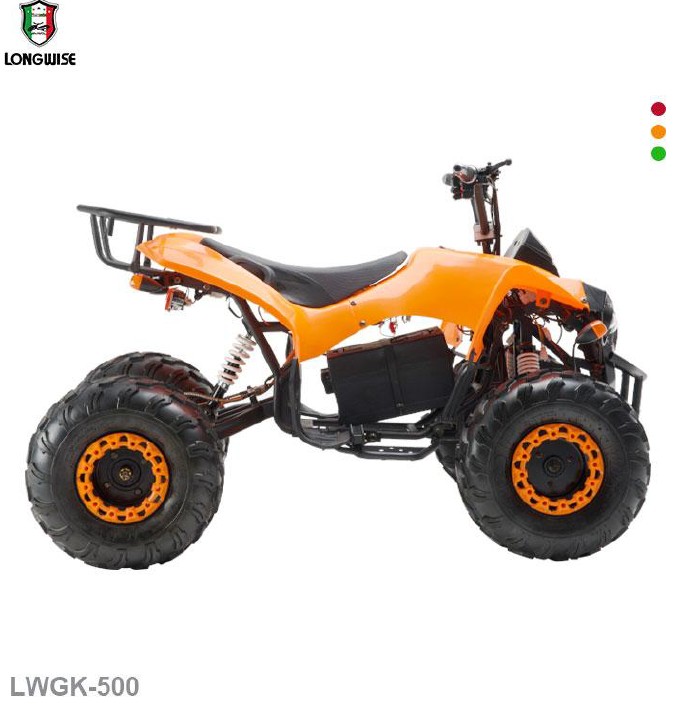
The LWGK-500 represents an electric beach drift ATV designed for eco-conscious recreational riding. Powered by a 500-1000W electric motor and 40V/20Ah lithium battery system, this zero-emission vehicle combines the fun of beach riding with environmental responsibility and low operating costs.
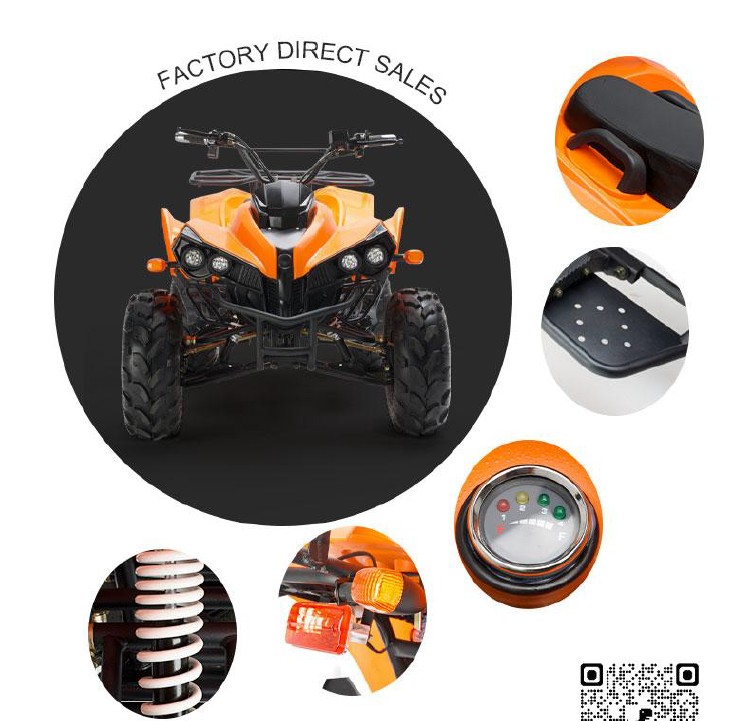
Built on a high-carbon steel frame with hydraulic disc brakes and 6-inch all-terrain tires, the LWGK-500 delivers practical performance for beach environments, rental operations, and light recreational use where quiet operation and zero emissions are valued. The compact 90kg weight makes it manageable for transport and storage.
Core Specifications
Detailed Technical Specifications
| Component | Specification | Details |
|---|---|---|
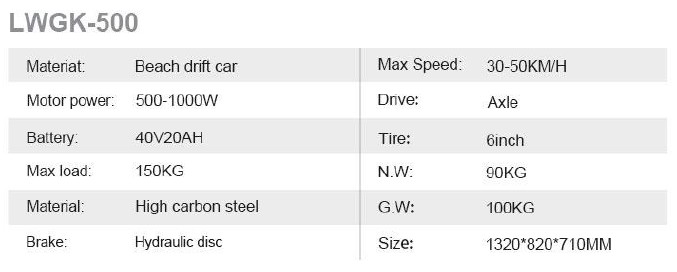
| Frame Material | High Carbon Steel | Welded tubular construction for durability |
| Motor Type | 500-1000W Electric Motor | Brushless DC motor (power varies by model variant) |
| Motor Controller | Intelligent Controller | Electronic speed control with multiple power modes |
| Battery Pack | 40V / 20Ah Lithium-Ion | Total capacity: 800 Watt-hours (Wh) |
| Battery Type | Lithium-Ion with BMS | Integrated Battery Management System for safety |
| Charging Time | 6-8 hours | Standard charging with included charger |
| Range per Charge | 30-50 km (estimated) | Varies with motor power, terrain, rider weight, speed |
| Maximum Speed | 30-50 km/h | Speed varies with motor power (500W vs 1000W variant) |
| Drive System | Direct Axle Drive | Motor mounted directly to rear axle for efficiency |
| Transmission | Single-Speed Direct Drive | No gearbox - simple and reliable |
| Brake System | Hydraulic Disc Brakes | Front and rear hydraulic disc for reliable stopping |
| Suspension | Front/Rear Swing Arm | Basic suspension with coil springs |
| Tire Specification | 6-inch All-Terrain | Small knobby tires for beach and light off-road |
| Maximum Load | 150 kg | Combined weight of rider plus cargo |
| Net Weight | 90 kg | Vehicle weight without battery and accessories |
| Gross Weight | 100 kg | Shipping weight including packaging |
| Overall Dimensions | 1320 x 820 x 710 mm | Length x Width x Height |
| Ground Clearance | Approximately 120-150mm | Suitable for beach and smooth trail terrain |
Ideal Use Cases
The LWGK-500 electric beach ATV fills a niche for environmentally-sensitive recreational riding where gasoline engines may be restricted or undesirable.
Primary Markets
- Beach Rental Operations (Eco-Friendly Tier): Appeal to environmentally-conscious tourists willing to pay premium for zero-emission experience
- Noise-Restricted Areas: Perfect for locations where gas engine noise prohibited (nature reserves, residential beach areas, noise-sensitive zones)
- Indoor/Covered Venues: Can operate indoors without ventilation concerns - ideal for indoor event venues or covered facilities
- Resort Properties: Quiet operation doesn't disturb resort guests - ideal for upscale hospitality properties
- Youth Recreation: Quieter, simpler operation makes it less intimidating for young riders (age 12+ with supervision)
- Urban Parks and Recreation Areas: Zero emissions and quiet operation suitable for municipal parks where gas ATVs prohibited
Secondary Applications
- Property Maintenance (Light Duty): Quiet transport for groundskeepers and maintenance staff
- Security Patrol: Silent operation ideal for nighttime security rounds without disturbing residents
- Beach Photography/Videography: Quiet motor doesn't interfere with audio recording
- Personal Recreation: Private property owners wanting fun electric recreational vehicle
Rider Profile
Height Range: 140-180 cm for comfortable control
Weight Limit: Maximum 150 kg combined rider and cargo
Experience Level: Beginner-friendly - simple throttle control, no clutch or shifting
Physical Requirements: Must be able to safely mount/dismount and reach controls
Electric vs Gasoline Advantages
Environmental Benefits:
- Zero emissions - no exhaust pollution
- Quiet operation (50-60 dB vs 85-95 dB for gas engines)
- No oil or fuel spills in sensitive beach environments
- Reduced carbon footprint - especially when charged from renewable energy
Operational Benefits:
- Lower operating costs - electricity much cheaper than gasoline per km
- Minimal maintenance - no oil changes, spark plugs, carburetors, exhaust systems
- Instant torque - electric motors deliver full power from standstill
- No warm-up required - ready to ride immediately
- Simpler operation - no choke, no starting procedures, just twist and go
Comparison: Electric vs Gasoline Models
| Feature | LWGK-500 (Electric) | LWGK-125 (Gas 125cc) |
|---|---|---|
| Power Source | 500-1000W Electric | 125cc Gasoline Engine |
| Top Speed | 30-50 km/h | 60 km/h |
| Range | 30-50 km per charge | 80-120 km per tank |
| Refuel Time | 6-8 hours charging | 2 minutes refueling |
| Noise Level | 50-60 dB (very quiet) | 85-90 dB (loud) |
| Emissions | Zero | Gasoline exhaust |
| Maintenance | Minimal (battery, brakes) | Regular (oil, plugs, carb) |
| Operating Cost | $0.50-1/100km | $4-6/100km |
| Best For | Eco-conscious, noise-restricted areas | Extended range, performance |
Long recharge time - not suitable for all-day continuous rental operations
Performance degrades as battery depletes - unlike gas which maintains power until empty
Cold weather reduces battery capacity and range significantly
NOT designed for: Heavy cargo hauling, extended touring, high-performance riding, deep water crossings
Lithium-Ion Battery Pack
The LWGK-500 utilizes a 40V/20Ah (800Wh) lithium-ion battery pack designed for electric vehicle applications, offering advantages over lead-acid batteries in energy density, weight, and cycle life.
Battery Specifications
| Parameter | Specification |
|---|---|
| Voltage | 40V Nominal (36V-42V operating range) |
| Capacity | 20Ah (Amp-hours) |
| Total Energy | 800 Wh (40V x 20Ah) |
| Battery Chemistry | Lithium-Ion (Li-Ion) |
| Battery Management | Integrated BMS with protection circuitry |
| Cycle Life | 500-800 charge cycles (2-4 years typical use) |
| Charging Time | 6-8 hours with standard charger |
| Operating Temp | -10C to +45C (avoid charging below 0C) |
| Weight | Approximately 12-15 kg |
Range and Performance
Range Estimates by Riding Condition
- 500W Motor Variant, Flat terrain, light rider (60kg), 25 km/h: 45-50 km range
- 500W Motor, Mixed terrain, average rider (75kg), 30 km/h: 35-40 km range
- 1000W Motor, Flat terrain, average rider, 40 km/h: 30-35 km range
- 1000W Motor, Hilly/sandy terrain, heavy rider (90kg), aggressive riding: 20-25 km range
- Cold weather (below 10C), any variant: Reduce estimates by 20-30%
Reduce rider weight - every 10kg saves approximately 5-8% range
Maintain moderate speeds (25-35 km/h) for best efficiency
Avoid full-throttle acceleration - smooth progressive throttle dramatically improves range
Keep tires properly inflated - under-inflation increases rolling resistance
Ride in moderate temperatures - extreme cold or heat reduces battery performance
Charging System
Charger Specifications
| Parameter | Value |
|---|---|
| Input Voltage | AC 100-240V, 50/60Hz (universal) |
| Output Voltage | DC 42V (charging voltage for 40V pack) |
| Output Current | 2-3A typical |
| Charging Time | 6-8 hours from empty to full |
| LED Indicator | Red = Charging | Green = Fully charged |
| Safety Features | Over-voltage, over-current, short-circuit protection |
Charging Procedure
- Park vehicle in well-ventilated area on level ground
- Turn off vehicle power switch
- Allow battery to cool 15-30 minutes if just finished riding
- Connect charger to vehicle charging port
- Plug charger into AC outlet (100-240V compatible)
- Verify LED shows RED (charging in progress)
- Wait 6-8 hours until LED turns GREEN (fully charged)
- Disconnect charger from wall first, then from vehicle
DO NOT charge immediately after riding - allow cooling period
NEVER charge in enclosed space - always well-ventilated area
AVOID charging below 0C - damages lithium batteries permanently
USE ONLY ORIGINAL CHARGER - incorrect voltage destroys battery pack
DO NOT leave battery fully discharged for extended periods - damages cells
Battery Maintenance
Best Practices for Long Battery Life
- Regular charging: Charge within 24 hours after each use
- Avoid full depletion: Charge when battery reaches 20-30% remaining
- Storage charge level: Store at 50-60% charge if unused for 1+ months
- Temperature protection: Store in temperature-controlled environment (15-25C ideal)
- Periodic cycling: If unused, charge/discharge every 2-3 months
- Monitor degradation: Track range over time - sudden drops indicate battery issues
Pre-Ride Inspection
| Item | Check | Acceptable Condition |
|---|---|---|
| Battery Charge | Check indicator gauge | Minimum 30% for intended ride |
| Tire Pressure | Visual and manual check | Firm with minimal deflection |
| Brakes | Test both front and rear | Firm lever feel, wheels lock |
| Throttle | Twist and release | Returns to closed immediately |
| Power Switch | Turn on/off | Indicator lights function properly |
| Steering | Turn full left/right | Smooth, no binding or play |
Basic Operation
Starting Procedure
- Mount vehicle from left side
- Ensure parking brake engaged (if equipped)
- Turn main power switch to ON position
- Wait for system initialization (1-2 seconds)
- Check battery indicator shows adequate charge
- Release parking brake
- Gently twist throttle to begin moving
Riding Techniques
- Smooth starts: Apply throttle gradually - instant electric torque can cause wheel spin if aggressive
- Throttle modulation: Small throttle movements have large effect - be gentle
- Regenerative braking: Some models may have regen - releasing throttle provides gentle engine braking
- Battery conservation: Constant moderate speed more efficient than start/stop riding
Maintenance Schedule
No oil changes, spark plugs, air filters, carburetor cleaning, exhaust service
Annual maintenance: approximately 2-3 hours vs 8-12 hours for gas ATV
Annual cost: $50-100 electric vs $200-400 gasoline
Regular Maintenance Tasks
| Interval | Tasks |
|---|---|
| Weekly | Check tire pressure | Inspect brake function | Verify battery charge level |
| Monthly | Lubricate moving parts | Check brake pads (min 3mm) | Inspect wiring for damage | Test all functions |
| Quarterly | Deep clean | Grease wheel bearings | Inspect suspension | Clean electrical connectors |
| Annually | Replace brake pads | Inspect tires for replacement | Service battery terminals | Complete system check |
Troubleshooting
| Problem | Possible Cause | Solution |
|---|---|---|
| Won't power on | Dead battery | Loose connection | Blown fuse | Charge battery | Check connectors | Replace fuse |
| Motor hums, no movement | Controller error | Motor fault | Mechanical binding | Reset power | Check motor connections | Inspect drivetrain |
| Reduced range | Battery degradation | Low tire pressure | Brake dragging | Test battery capacity | Inflate tires | Adjust brakes |
| Intermittent power | Loose battery connection | Faulty controller | Wiring issue | Tighten battery | Inspect controller | Check all wiring |
| Won't charge | Faulty charger | Damaged port | BMS protection | Test charger | Inspect port pins | Reset BMS (disconnect 10 min) |
Wholesale Pricing
Note: Database shows $0.17 which is clearly incorrect. Typical electric ATV wholesale pricing ranges $700-1000 depending on battery capacity and motor power.
Volume Pricing
| Quantity | Typical Discount | Best For |
|---|---|---|
| 3-10 units | List price | Eco-rental start-ups, private buyers |
| 11-25 units | 5-10% off | Established rental operations |
| 26-50 units | 10-15% off | Resort chains, distributors |
| 51-100 units | 15-20% off | Large fleet operators |
| 100+ units | 20-30%+ off | Private label, OEM programs |
Customization Options
- Motor Power: Choose 500W, 750W, or 1000W variants
- Battery Capacity: Upgrade to higher-capacity batteries (25Ah, 30Ah) for extended range
- Color Options: Custom frame and body panel colors (MOQ 10 units)
- Branding: Fleet branding, custom graphics, company logos
Shipping
Container Loading
| Container Type | Capacity |
|---|---|
| 20' Standard | 55-65 units |
| 40' Standard | 120-140 units |
| 40' High Cube | 140-160 units |
HS Code: 8711.60 - Electric motorcycles and cycles with electric motor for propulsion
Q: Electric vs gasoline - which is better?
Depends on priorities. Electric (LWGK-500) advantages: Zero emissions, very quiet (50-60 dB), lower operating costs (80-90% cheaper), minimal maintenance, simple operation. Gasoline (LWGK-125) advantages: Longer range (80-120km vs 30-50km), faster refueling (2 min vs 6-8 hr), higher top speed (60 vs 30-50 km/h), better cold weather performance. Choose electric for eco-conscious operations, noise-restricted areas, short rides. Choose gas for extended range, all-day rentals, performance.
Q: What is the real-world range?
Highly variable. Best case (500W motor, light rider, flat terrain, 25 km/h): 45-50 km. Typical (mixed conditions, average rider): 30-35 km. Worst case (1000W motor, heavy rider, hills/sand, aggressive riding, cold weather): 20-25 km. Most rental operations achieve 30-40 km per charge under normal use.
Q: How long does charging take?
Standard charging: 6-8 hours from empty to full with included charger. Fast charging not typically available for this battery size. For rental operations, recommend having spare charged batteries or charging overnight between rental days. Battery swap (if designed for it) takes 5-10 minutes vs 6-8 hour charge.
Q: What happens if battery dies while riding?
Vehicle stops - no pedaling, no push-assist. Prevention critical: Monitor battery indicator constantly, turn back at 50% charge, plan conservative routes. If stranded: Vehicle weighs 90kg (lighter than gas models) - possible to push on flat ground but difficult uphill. Call for pickup. For rental operations, GPS tracking and battery monitoring essential.
Q: Is 500W enough power?
Depends on expectations. 500W variant (if available) adequate for: Single rider up to 80kg on flat/moderate terrain, casual beach riding at 25-35 km/h, beginner riders. 1000W variant better for: Heavier riders (80-110kg), hilly terrain, faster acceleration, sustained 40-50 km/h speeds. Trade-off: 1000W provides better performance but reduces range by 20-30%.
Q: What maintenance is required?
Minimal vs gasoline. No oil changes, spark plugs, air filters, carburetor service. Main tasks: Weekly tire pressure check, monthly brake inspection, quarterly lubrication of moving parts, annual brake pad replacement, keep battery terminals clean. Total maintenance time: 2-3 hours per year vs 8-12 hours for gas ATV. Cost: $50-100/year vs $200-400 for gas.
Q: Can it be used in rain or water?
Water-resistant but not waterproof. Safe: Light rain, shallow puddles (5-10cm), washing with gentle spray. Unsafe: Heavy rain, water deeper than footrests, pressure washing battery/motor, submersion, salt water. After wet riding, dry thoroughly before charging. Water in electrical system = dangerous short circuits.
Q: How does it perform in cold weather?
Lithium batteries lose capacity in cold. Below 10C: 10-15% range reduction. Below 0C: 20-30% range reduction. Below -10C: 30-40% range reduction, may not start. Never charge below 0C - causes permanent battery damage. For cold climates, consider heated battery systems or gas-powered alternatives.
Q: What is the operating cost comparison?
Electric LWGK-500: Battery 800Wh, charging efficiency 85% = 0.94 kWh from wall. At $0.15/kWh = $0.14 per charge. Range 35km average = $0.40 per 100km. Annual (1000km): $4 electricity + $75 maintenance = $79 total. Gasoline LWGK-125: 4L/100km at $1.50/L = $6/100km fuel. Annual (1000km): $60 fuel + $200 maintenance = $260 total. Savings: $180+/year with electric.