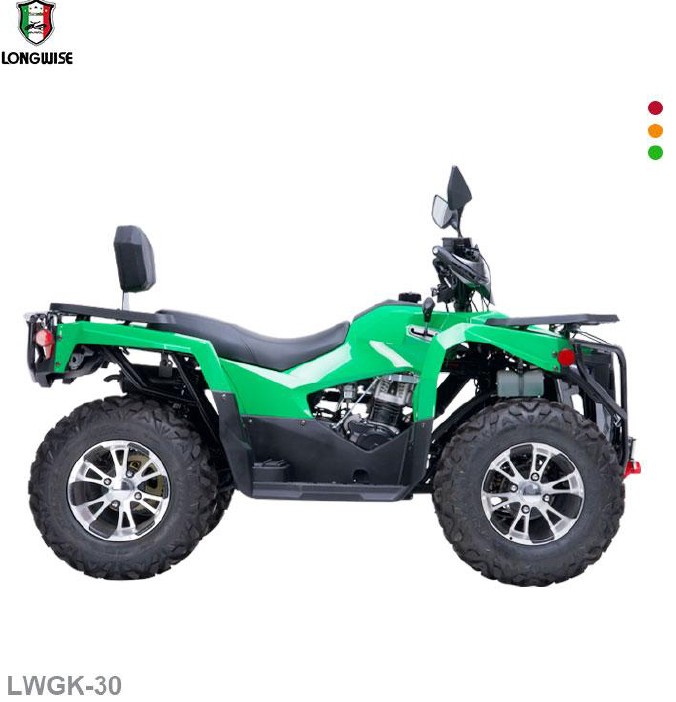
LONGWISE LWGK30 PETROL DRIFT BEACH KART
Product Specifications
| LONGWISE | LWGK30 |
Product Overview
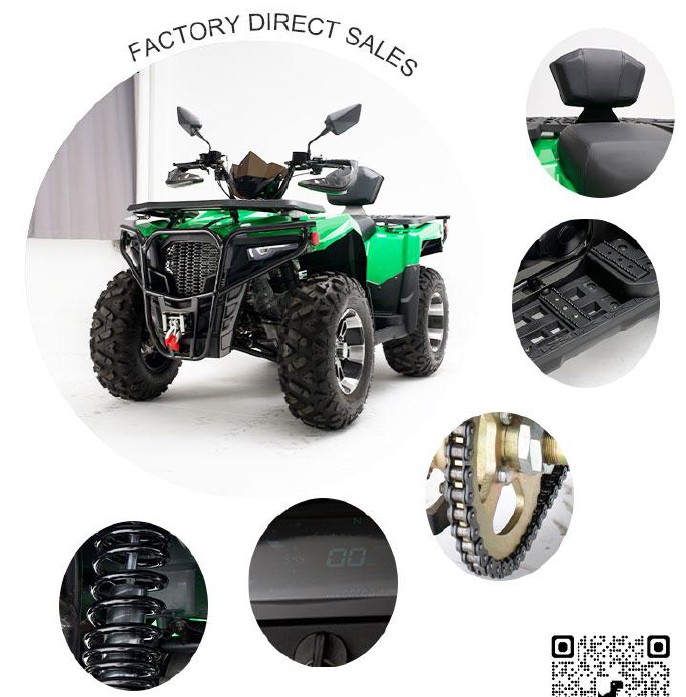
The LWGK-30 represents a full-size beach drift ATV featuring a powerful 300cc 4-stroke engine, professional double A-arm independent suspension, and robust 12-inch all-terrain tires. This premium recreational ATV is specifically engineered for serious beach riding, sand dune exploration, and aggressive off-road use where performance and capability take priority.
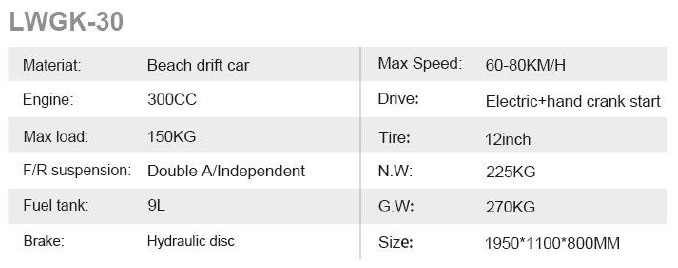
Distinguished by its substantial 225kg build weight, independent front and rear suspension systems, and dual starting methods (electric plus manual hand crank), the LWGK-30 delivers authentic off-road performance. The 9-liter fuel tank provides extended riding range, while hydraulic disc brakes ensure confident stopping power in challenging terrain.
Core Specifications
Detailed Technical Specifications
| Component | Specification | Details |
|---|---|---|
| Engine Type | 300cc 4-Stroke Gasoline | Air-cooled or liquid-cooled single cylinder (depending on variant) |
| Power Output | Approximately 18-22 HP | Estimated horsepower at 7000-8000 RPM |
| Starting System | Electric + Hand Crank | Primary electric start with manual backup hand crank starter |
| Fuel System | Carburetor or EFI | Carburetor standard, optional electronic fuel injection |
| Fuel Tank Capacity | 9 liters | Extended range: 150-200km per tank depending on terrain |
| Transmission | Automatic CVT | Continuously variable transmission with reverse gear |
| Drive System | Chain Drive 2WD | Rear-wheel drive with heavy-duty chain |
| Front Suspension | Double A-Arm Independent | Professional independent suspension with coil-over shocks |
| Rear Suspension | Independent Suspension | Independent rear suspension for superior ride quality |
| Suspension Travel | 150-200mm front/rear | Extended travel for absorbing large bumps and jumps |
| Brake System | Hydraulic Disc Brakes | 4-wheel hydraulic disc brakes for maximum stopping power |
| Tire Specification | 12-inch All-Terrain | Aggressive knobby tires: Front 20x7-12 / Rear 22x10-12 (typical) |
| Wheelbase | Approximately 1250mm | Longer wheelbase for stability at speed |
| Ground Clearance | 200-250mm | High ground clearance for obstacle navigation |
| Maximum Speed | 60-80 km/h | Top speed varies with rider weight and terrain |
| Maximum Load | 150 kg | Rider plus cargo capacity |
| Net Weight | 225 kg | Dry weight without fuel or accessories |
| Gross Weight | 270 kg | Shipping weight with packaging |
| Overall Dimensions | 1950 x 1100 x 800 mm | Length x Width x Height |
Professional Beach and Dune Riding
The LWGK-30 is purpose-built for demanding beach and sand dune environments where lighter ATVs struggle. The 300cc engine provides ample power for climbing steep dunes, while the 225kg weight offers stability in crosswinds common to coastal areas.
Primary Use Cases
- Beach Rental Operations (Premium Tier): High-performance rental option for experienced riders willing to pay premium rates
- Sand Dune Recreation Parks: Designed for aggressive dune riding with extended suspension travel and powerful engine
- Coastal Property Owners: Capable transport for navigating large coastal properties with varied terrain
- Beach Patrol and Lifeguard Services: Fast response vehicle for patrolling extensive beach areas
- Desert Safari Operations: Tourist experience vehicles for desert and sand dune tours
- Film and Photography: Camera crew transport in beach and desert filming locations
Secondary Applications
- Agricultural Use (Sandy Soil): Farm transport and inspection on sandy agricultural land
- Construction Site Access: Navigating sandy construction sites and beach development projects
- Search and Rescue: Quick-response vehicle for beach and coastal emergency operations
- Resort and Hotel Transport: Guest transport across large beachfront resort properties
Rider Profile and Skill Requirements
Height: 160-190 cm for optimal riding position and control
Weight Limit: Maximum 150 kg combined rider and cargo
Experience Level: Intermediate to advanced riders - substantial power requires throttle control skills
Licensing: Check local regulations - may require motorcycle license or ATV certification
Performance Characteristics
Power and Acceleration: The 300cc engine delivers approximately 18-22 horsepower, providing brisk acceleration and strong hill-climbing capability. Experienced riders will appreciate the responsive power delivery, while beginners may find it intimidating.
Handling and Stability: At 225kg, the LWGK-30 is substantially heavier than 125cc models, providing excellent stability at higher speeds and in crosswinds. The longer wheelbase (approximately 1250mm) enhances straight-line stability but reduces agility in tight spaces.
Suspension Performance: Independent front and rear suspension with 150-200mm travel absorbs large bumps, jumps, and rough terrain that would bottom out lesser ATVs. This makes aggressive riding more comfortable and safer.
Comparison to LWGK-125
| Feature | LWGK-125 | LWGK-30 |
|---|---|---|
| Engine | 125cc (~8-10 HP) | 300cc (~18-22 HP) |
| Top Speed | 60 km/h | 60-80 km/h |
| Weight | 110 kg (lightweight) | 225 kg (stable) |
| Suspension | Basic swing arm | Independent double A-arm |
| Tires | 6-inch (limited) | 12-inch (aggressive) |
| Fuel Tank | 4L (80-120km range) | 9L (150-200km range) |
| Best For | Beginners, light use | Experienced riders, serious off-road |
300cc engine produces significant power - respect throttle input
225kg weight requires strength to maneuver when stuck or loading onto trailer
NOT street-legal in most jurisdictions - off-road use only
Protective gear MANDATORY: helmet, goggles, gloves, boots, body armor recommended
300cc 4-Stroke Engine
The LWGK-30 features a robust 300cc 4-stroke single-cylinder engine designed for demanding off-road use. This displacement class represents the sweet spot between power and reliability for recreational ATVs.
Engine Performance
| Parameter | Specification |
|---|---|
| Displacement | 300cc (approximately 18.3 cubic inches) |
| Power Output | 18-22 horsepower (estimated) |
| Torque | 20-25 Nm (estimated peak torque) |
| Cooling System | Air-cooled or liquid-cooled (variant dependent) |
| Valvetrain | SOHC or DOHC (2 or 4 valves) |
| Fuel System | Carburetor or Electronic Fuel Injection |
| Starting | Electric starter (12V) plus manual hand crank backup |
| Fuel Type | Regular unleaded gasoline (87-91 octane) |
| Oil Capacity | 1.5-2.0 liters (15W-40 or 10W-40 motorcycle oil) |
Fuel Economy and Range
Fuel Consumption: Approximately 5-7 liters per 100km depending on riding style, terrain, and rider weight. Aggressive dune riding increases consumption to 8-10 L/100km.
Tank Capacity: 9-liter fuel tank provides excellent range for extended riding sessions.
Range per Tank:
- Conservative riding (trails, moderate speeds): 150-180 km
- Typical recreational use (mixed speeds, varied terrain): 120-150 km
- Aggressive dune riding (high speeds, deep sand): 90-120 km
Strong hill-climbing ability - handles steep dunes and inclines
Maintains speed with cargo or accessories installed
More reliable than highly-tuned smaller engines at sustained high output
Better resale value - 300cc is popular displacement for used market
Dual Starting System
The LWGK-30 includes both electric start and manual hand crank starting systems, providing redundancy for remote riding situations.
Electric Start System
- Primary Method: Push-button electric starter powered by 12V battery
- Convenience: Essential for rental operations and casual riders
- Battery: 12V lead-acid battery (requires periodic charging if vehicle unused for weeks)
- Charging System: Engine-driven alternator maintains battery charge during operation
Hand Crank Backup System
- Manual Operation: Hand crank engages engine directly, no electrical power required
- Reliability: Critical backup if battery dies in remote location
- Technique: Requires proper technique - decompress engine, apply choke, pull crank firmly
- Physical Effort: More demanding than electric start, requires upper body strength
Transmission and Drivetrain
CVT Automatic Transmission
Continuously Variable Transmission (CVT) with reverse gear eliminates manual clutch operation and gear shifting.
- Operation: Automatic belt-driven system adjusts gear ratio continuously
- Reverse Gear: Electronic or mechanical reverse for backing out of difficult situations
- Maintenance: CVT belt requires inspection every 50-100 hours, replacement every 500-1000 hours
- Performance: Optimized for low-end torque and mid-range power delivery
Drive System
- Configuration: Rear-wheel drive (2WD) via chain final drive
- Chain Type: Heavy-duty sealed chain for reduced maintenance
- Gear Ratio: Optimized for balance between acceleration and top speed
Independent Suspension System
The LWGK-30's defining feature is its professional-grade independent suspension both front and rear - a significant upgrade over basic swing-arm designs found on entry-level ATVs.
Front Suspension: Double A-Arm Independent
Design: Upper and lower A-arms with coil-over shock absorbers provide true independent wheel movement.
Advantages:
- Each front wheel reacts independently to terrain - improved traction and control
- Reduced body roll in corners compared to solid axle designs
- Better absorption of single-wheel impacts (rocks, logs, large bumps)
- More precise steering response and feedback
Specifications:
- Suspension travel: Approximately 150-180mm front
- Shock type: Coil-over spring with hydraulic damper
- Adjustability: May include preload adjustment on shock springs
Rear Suspension: Independent
Design: Independent rear suspension (IRS) allows each rear wheel to move independently.
Advantages:
- Superior ride comfort over rough terrain
- Maintains rear wheel contact on uneven surfaces for better traction
- Reduces wheel hop and skipping on washboard terrain
- Allows aggressive cornering without inside wheel lift
Specifications:
- Suspension travel: Approximately 150-200mm rear
- Shock mounting: Coil-over shocks with progressive spring rates
Handling Characteristics
Stability
At 225kg, the LWGK-30 provides excellent stability at higher speeds and in crosswinds. The substantial weight resists being blown off course on windy beach conditions. Longer 1250mm wheelbase further enhances straight-line stability.
Agility
Trade-off for stability is reduced agility in tight spaces. The LWGK-30 requires wider turning radius than lighter 125cc models. Best suited for open beach and dune riding rather than tight forest trails.
Ride Quality
Independent suspension delivers exceptional ride comfort. Large bumps, jumps, and rough terrain are absorbed effectively, reducing rider fatigue on long rides.
Hard-Pack: Soften suspension for better small-bump compliance
Jumping: Maximum preload to handle landing impacts
Two-Up Riding: Increase rear preload to compensate for passenger weight
Tire Specifications
12-Inch All-Terrain Tires
Typical Size: Front: 20x7-12 | Rear: 22x10-12
Construction: 6-ply or 8-ply rating for puncture resistance and sidewall strength
Tread Pattern: Aggressive knobby design for sand, dirt, and mixed terrain
Recommended Pressure:
- Hard surfaces: 10-12 PSI front, 8-10 PSI rear
- Soft sand/dunes: 5-7 PSI front, 4-6 PSI rear (for flotation)
- Mixed terrain: 8-10 PSI front, 6-8 PSI rear
Pre-Ride Inspection
| Item | Check | Action |
|---|---|---|
| Fuel Level | Check gauge or tank visually | Refuel if below 1/4 tank |
| Engine Oil | Check dipstick - FULL mark | Add 10W-40 or 15W-40 if low |
| Coolant (if liquid-cooled) | Check reservoir level | Top up with 50/50 coolant mix |
| Tire Pressure | Use gauge - adjust for terrain | Inflate to appropriate PSI |
| Brakes | Test all four brakes | Should be firm, progressive |
| Chain | Check tension and lubrication | Adjust if loose, lubricate |
| Battery | Check terminals clean and tight | Clean corrosion, tighten |
Maintenance Schedule
Regular Service Intervals
| Interval | Service Tasks |
|---|---|
| Every 10 hours | Lubricate chain | Clean air filter | Check tire pressure |
| Every 20-30 hours | Change engine oil | Check/adjust chain tension | Inspect brakes |
| Every 50 hours | Replace air filter | Check spark plug | Grease suspension pivots | Inspect CVT belt |
| Every 100 hours | Replace spark plug | Change coolant (liquid-cooled) | Replace CVT belt | Valve clearance check |
| Annually | Complete service | Replace brake fluid | Inspect all systems | Deep clean and degrease |
Clean air filter after EVERY beach ride - critical for engine longevity
Lubricate chain more frequently - sand acts as grinding paste
Wash vehicle thoroughly after beach use to remove salt and sand
Inspect brake pads regularly - sand contamination increases wear 50-100%
Critical Maintenance Procedures
Engine Oil Change (Every 20-30 hours)
- Warm engine 2-3 minutes, shut off
- Position drain pan under engine
- Remove drain bolt, drain oil completely (10-15 minutes)
- Replace drain bolt with new crush washer
- Add 1.5-2.0L of 10W-40 or 15W-40 motorcycle oil
- Check dipstick - oil at FULL mark
- Start engine 30 seconds, recheck level
CVT Belt Inspection (Every 50 hours)
- Remove CVT cover (usually left side of engine)
- Inspect belt for cracks, fraying, or glazing
- Measure belt width - replace if worn beyond service limit
- Clean CVT faces with brake cleaner
- Reinstall cover with new gasket
Troubleshooting
| Problem | Possible Cause | Solution |
|---|---|---|
| Engine won't start (electric) | Dead battery | Loose connection | Bad starter | Charge battery | Check connections | Use hand crank |
| Engine won't start (hand crank) | No fuel | Fouled plug | Flooded engine | Refuel | Replace plug | Wait 10 min, try again |
| Loss of power | Dirty air filter | Worn CVT belt | Low compression | Clean/replace filter | Replace belt | Engine rebuild needed |
| Overheating | Low coolant | Blocked radiator | Thermostat stuck | Add coolant | Clean radiator fins | Replace thermostat |
| Poor handling | Incorrect tire pressure | Worn shocks | Loose suspension | Adjust pressure | Replace shocks | Tighten bolts |
Wholesale Pricing
Note: Database shows $0.17 price which is clearly an error. Typical wholesale pricing for 300cc ATVs ranges $1000-1500 depending on features and volume.
Volume Pricing Structure
| Quantity | Typical Discount | Best For |
|---|---|---|
| 3-10 units | Base price | Rental operations, dealers |
| 11-25 units | 8-12% off | Multi-location rentals, distributors |
| 26-50 units | 12-18% off | Resort chains, large distributors |
| 51-100 units | 18-25% off | National chains, fleet operators |
| 100+ units | 25-35% off | Private label, OEM programs |
Shipping and Logistics
Packaging
- Net Weight: 225 kg per unit
- Gross Weight: 270 kg including crate and packaging
- Assembly Required: Handlebars, wheels, seat, accessories (2-3 hours)
Container Loading
| Container Type | Approximate Capacity |
|---|---|
| 20' Standard | 20-25 units |
| 40' Standard | 45-55 units |
| 40' High Cube | 55-65 units |
HS Code: 8711.30 - Motorcycles with reciprocating internal combustion piston engine of cylinder capacity exceeding 250cc but not exceeding 500cc
Q: How does the LWGK-30 compare to the LWGK-125?
The LWGK-30 is significantly more powerful and capable. Key differences: 300cc vs 125cc engine (2-3x more power), 225kg vs 110kg weight (more stable), 12-inch vs 6-inch tires (better traction), independent suspension vs basic swing arm (superior handling), 9L vs 4L fuel tank (2x range). LWGK-30 is for experienced riders wanting serious performance, while LWGK-125 suits beginners.
Q: Is the 300cc engine powerful enough for two riders?
Yes, the 18-22 HP output handles two-up riding adequately on moderate terrain. Performance with passenger: reduced acceleration, lower top speed (approximately 50-60 km/h vs 70-80 km/h solo), increased fuel consumption. For frequent two-up riding, consider upgrading to larger 400-500cc models if available.
Q: What is fuel consumption and operating cost?
Fuel consumption: 5-7 L/100km normal riding, 8-10 L/100km aggressive dune riding. With 9L tank, range is 120-180km. At $1.50/L fuel: $7.50-15 per 100km. Annual maintenance (100 hours use): approximately $300-500 including oil changes, filters, CVT belt, chain/sprockets, brake pads.
Q: Why electric start AND hand crank?
Redundancy for reliability in remote locations. Electric start provides convenience for normal use. Hand crank ensures you can start vehicle if battery dies miles from civilization. For rental operations, electric start is essential. For desert/beach expeditions, hand crank backup is critical safety feature.
Q: Can it handle deep soft sand?
Yes, better than smaller ATVs. 300cc power maintains momentum in soft sand. 12-inch tires provide good flotation when deflated to 4-6 PSI. 225kg weight is disadvantage initially (harder to get moving) but advantage once moving (maintains momentum). Technique matters: keep speed up, smooth throttle, weight rearward.
Q: How difficult is maintenance compared to 125cc models?
Moderately more complex. Larger engine requires more oil (2L vs 1L), larger air filter, potentially liquid cooling system. CVT belt is heavier-duty but also more expensive to replace. Independent suspension has more grease points. However, maintenance intervals similar. Expect 20-30% higher annual maintenance costs vs 125cc.
Q: Is it suitable for beginners?
NOT recommended for complete beginners. 300cc power can be intimidating for inexperienced riders. 225kg weight difficult to handle when stuck or loading. Recommend starting on 125-200cc ATV first, then upgrading to 300cc after developing skills. Minimum age recommendation: 16+ with prior ATV experience, or 18+ for new riders.
Q: What is maximum towing capacity?
Not designed for towing. Rear-wheel drive and recreational suspension unsuitable for trailer loads. Light utility work acceptable (small cargo rack with 20-30kg load). For serious towing, consider purpose-built utility ATVs with 4WD and towing package.
Q: How does independent suspension improve performance?
Independent suspension allows each wheel to react to terrain independently. Benefits: Better traction (all four wheels stay planted on uneven ground), improved cornering (reduced body roll), superior ride comfort (large bumps absorbed without jarring whole vehicle), more precise steering. Significant upgrade over basic swing-arm designs on budget ATVs.