BMW/MINI 31126774826 ARM SUB-ASSY
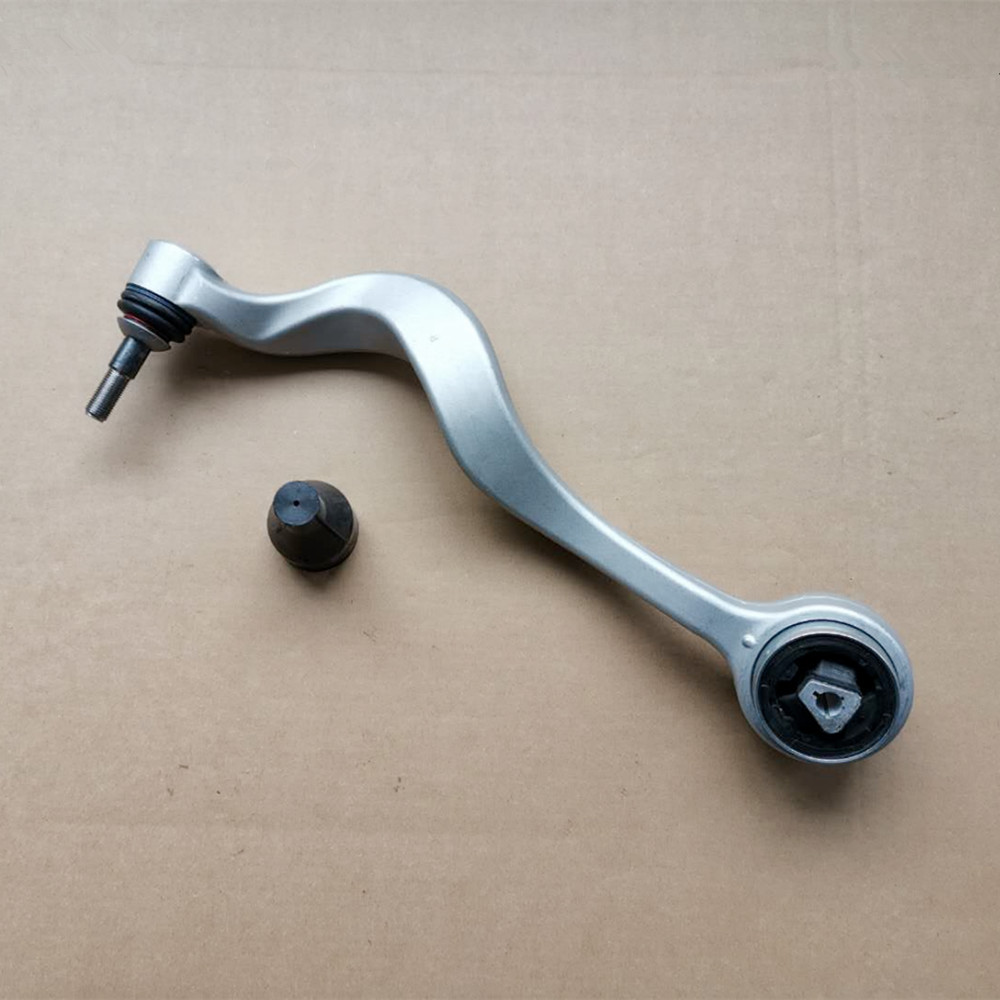
Product Specifications
| BMW/MINI | 31126774826 |
| BMW/MINI | 31126765996 |
| BMW/MINI | 31104026720 |
| BMW/MINI | 31124046438 |
| BMW/MINI | 31126760184 |
| BMW/MINI | 31120305612 |
| BMW/MINI | 31102348046 |
| BRILLIANCE | 31104026720 |
| BRILLIANCE | 31126760184 |
| BRILLIANCE | 31126765996 |
| MILES | DB62285 |
The BMW 31126774826 is a Front Lower Rearward Control Arm — Right Side (also called "bent arm", "wishbone", or "rear position control arm") for the BMW 5 Series E60 / E61 Touring (2002–2010). It is the rearward of the two lower arms on each side of the front suspension — it runs from the front subframe to the lower part of the steering knuckle and carries lateral and longitudinal loads during braking, steering, and cornering. The arm incorporates a hydraulic fluid-filled bushing at the subframe end and a ball joint at the knuckle end. Fits all E60 saloon and E61 estate variants including 520d, 520i, 523i, 525i/xi, 525d, 528i, 530i/xi, 530d, 535i, 535d, 540i, 545i, 550i, and M5.
The E60 front suspension uses a dual lower arm geometry — two separate lower arms on each side connect the subframe to the steering knuckle. The forward arm (tension strut) takes primarily longitudinal braking loads. The rearward arm — this component — takes primarily lateral cornering loads and works with the tension strut to triangulate the lower end of the suspension. Together they define the front wheel’s position in space and the suspension’s instantaneous centre of rotation through its travel.
The arm has two points of compliance. At the subframe end, a hydraulic fluid-filled bushing provides controlled stiffness in the lateral direction while damping high-frequency road inputs in the longitudinal direction. This bushing is the primary wear point — over time the internal fluid leaks through fatigue cracks in the rubber chamber walls and the bushing loses its damping characteristic. At the knuckle end, an integrated ball joint allows the suspension to articulate vertically while constraining horizontal movement.
When the hydraulic bushing fails, suspension compliance becomes uncontrolled: the arm moves excessively under load, wheel alignment shifts dynamically, and NVH damping is lost. The characteristic failure symptoms on the E60 are knocking over bumps, steering wander, front-end shake above 100 km/h, and uneven inner-edge tyre wear. BMW’s own service literature notes that the hydraulic bushing is the most common wear item on the E60 front suspension and is the primary reason this arm is replaced.
| International HS Code | 8708.80 |
| EAEU Customs Code (TN VED) | 8708 80 350 0 |
| Country of Manufacture | China |
| Quality | OEM equivalent grade |
| Hazardous goods | No |
| Packaging | Individually packed — export-ready |
Suspension arms for motor vehicles are classified under HS 8708.80 (suspension systems and parts thereof). Verify the exact 10-digit subheading and applicable duty rates with your customs broker. Commercial invoice description: Front lower suspension control arm for motor vehicle.
| Model | Body / Years | Notes |
|---|---|---|
| BMW 5 Series E60 Saloon | 2002–2010 | All RWD variants: 520d, 520i, 523i, 525d, 525i, 528i, 530d, 530i, 535d, 535i, 540i, 545i, 550i, M5 |
| BMW 5 Series E60 xDrive | 2005–2010 | 525xi, 528xi, 530xi, 535xi (and xDrive versions); confirm by VIN |
| BMW 5 Series E61 Touring | 2004–2010 | All variants including 525d, 525i, 530d, 530i, 535d, 545i, 550i estate |
| BMW 5 Series E61 xDrive Touring | 2005–2010 | 525xi, 530xi, 530xd xDrive estates; confirm by VIN |
| FAW-BMW (China-market E60) | 2004–2010 | Brilliance-badged Chinese production E60 5 Series |
M5 and high-output V8 variants use the same front lower rearward arm as standard E60 variants. BMW made several running production changes to the lower arm during E60 production — the multiple OEM cross-reference numbers (31126765996, 31104026720, 31126760184, 31124046438, 31102348046, 31120305612) are all right-side variants across these production runs. Verify against the number stamped on your existing arm.
Difficulty: Moderate. Estimated time: 1–2 hours per side. Subframe mounting bolts on high-mileage E60s are frequently severely corroded — apply penetrating oil 24 hours before the job. A full 4-wheel alignment is mandatory after fitting — the vehicle must not return to road use until alignment is confirmed.
- 1Apply penetrating oil to all arm mounting bolts at least 24 hours before work — the subframe pinch bolt and the ball joint pinch bolt are both under the arch and accumulate severe corrosion on E60s in salted climates. Soaking overnight reduces bolt breakage significantly.
- 2Raise and support the vehicle on axle stands at the manufacturer-approved jacking points. Remove the front-right wheel. Apply the parking brake and chock the rear wheels.
- 3Support the steering knuckle with a hydraulic jack from below before disconnecting any fastener — without support the hub drops to full droop when the arm is released, stressing the brake hose, ABS cable, and CV joint on xDrive variants. Lift the knuckle until the suspension is at approximate ride height.
- 4Disconnect the ball joint at the knuckle. The E60 uses a pinch bolt (not a taper nut). Remove the pinch bolt fully. The integrated ball joint uses a Torx 40 anti-rotation hole in the end of the shank to prevent the stud from spinning when the pinch bolt is loosened — use the Torx hole rather than the traditional “jack under the hub” method recommended on older BMWs.
- 5Remove the subframe mounting bolt that secures the arm’s hydraulic bushing to the subframe. Note any BMW reinforcement plate fitted over the bushing — BMW service literature specifies the plate should be removed for access. Extract the arm.
- 6Compare the new arm to the old one before fitting — confirm arm length, bushing dimensions, ball joint taper, and pinch-bolt hole position. Verify any eccentric washers or offset bolts retain their orientation from removal (photograph before removing them).
- 7Install the new 31126774826. Start all bolts by hand to avoid cross-threading. Tighten the subframe bushing bolt with the suspension at ride height, not at full droop — tightening at full droop pre-loads the hydraulic bushing in the wrong position and causes premature bushing failure. Torque per BMW workshop manual: subframe bolt typically 100–110 Nm (check by year); ball joint pinch bolt typically 55–65 Nm — verify in workshop data for your specific variant.
- 8Refit the wheel and torque wheel bolts to 140 Nm. Lower the vehicle. Perform a full 4-wheel alignment before road testing — wheel camber, caster, and toe will have shifted from their previous values and must be reset.
| Part | Reference | Reason for Combined Replacement |
|---|---|---|
| Left-side Rearward Lower Control Arm | BMW 31126774825 (left-side counterpart) | The left-side arm accumulates identical mileage and environmental exposure to the right-side arm. On any E60 above 100,000 km with one failed side, the other side is statistically at the same stage of hydraulic bushing fatigue. Since the 4-wheel alignment must be performed after fitting one arm anyway, replacing both sides in the same workshop visit eliminates a probable second workshop visit within a short interval and a second alignment charge. Almost always supplied as a left + right pair for E60 service. |
| Front Forward Lower Control Arm (Tension Strut) | BMW E60 front tension strut — left and right pair — confirm by year and variant | The tension strut is the forward of the two lower arms on each side of the E60 front suspension. It uses a different bushing design (also hydraulic fluid-filled, but different profile) and fails from the same environmental causes on the same mileage curve as the rearward arm. BMW’s own service literature recommends replacing all four lower arms (both rearward + both tension struts) as a complete front suspension refresh on high-mileage E60s. Since the full front suspension is already disassembled for rearward arm access, combining the tension strut replacement adds minimal additional labour time. |
| Subframe Mounting Hardware / Stretch Bolts | BMW 5 Series E60 subframe and control arm hardware kit | Subframe and control arm mounting bolts on the E60 are torque-to-yield stretch bolts that must not be reused after removal. Reusing previously stretched TTY bolts risks under-clamping and progressive loosening under load. BMW specifies new hardware for every control arm replacement — the bolt kit should be ordered alongside the arm to ensure the new arm is properly fastened with the correct single-use hardware. |
| Front Anti-Roll Bar Drop Links | BMW 5 Series E60 front anti-roll bar drop links (left and right) | The anti-roll bar drop links mount between the anti-roll bar and the front strut on the E60. They are fully accessible with the front suspension already disassembled for lower arm replacement. On high-mileage E60s the drop link ball joints are typically worn and are a common cause of front-end rattle that would otherwise be attributed to the new lower arm. Replacing drop links simultaneously with the lower arms eliminates a secondary noise source and a probable return to the workshop within a short period. |