ABS Wheel Speed Sensors: Complete Technical and Wholesale Sourcing Guide
A deep-dive into ABS sensor technology, failure diagnostics, OEM cross-references by vehicle brand, and how to source wholesale from China through verified factories.
The ABS wheel speed sensor is one of the most frequently replaced electronic components in the modern vehicle. Every car built since the mid-2000s has four of them - one at each wheel - and they feed data not just to the anti-lock braking system, but also to traction control, electronic stability control, cruise control, and in many cases the speedometer itself. When one fails, multiple systems go offline simultaneously.
For auto parts distributors and importers, ABS sensors represent a high-margin, high-demand product category with strong repeat business. For mechanics and technical buyers, understanding the differences between sensor types, diagnostic methods, and OEM cross-references is essential for correct part selection.
This guide covers both angles: the technical fundamentals that every buyer needs to understand, and the sourcing and wholesale economics that make ABS sensors one of the most profitable categories in the aftermarket. The full ok.parts ABS sensor catalog is available for browsing by OEM number, vehicle application, or manufacturer.
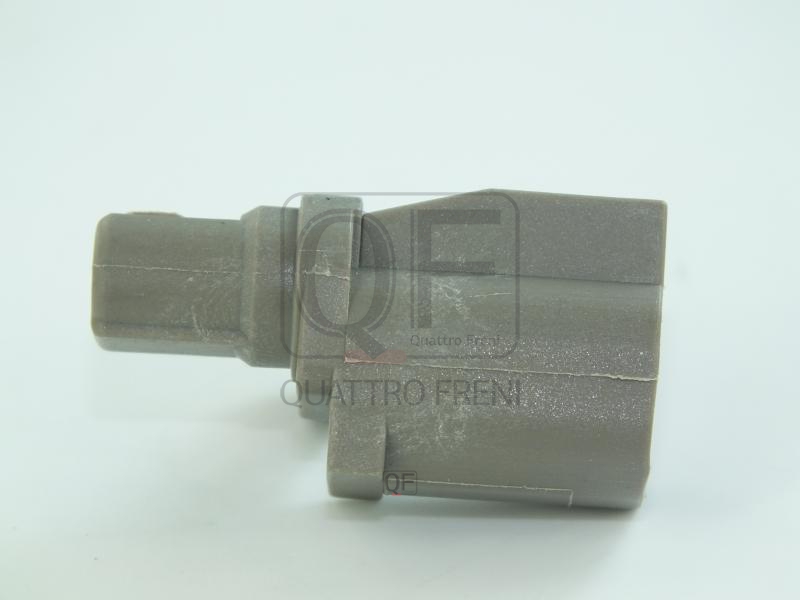
Compact Hall-effect ABS wheel speed sensor - one of the most common types in modern vehicles. View in catalog
1. How ABS Wheel Speed Sensors Work
An ABS wheel speed sensor is mounted at each wheel hub or steering knuckle, positioned with a precise air gap facing a toothed reluctor ring (also called a tone ring or trigger wheel). As the wheel rotates, the teeth of the reluctor ring pass the sensor face, and the sensor converts this rotation into an electrical signal that the ABS control module interprets as wheel speed.
The ABS module continuously compares the speed signals from all four wheels. If one wheel decelerates significantly faster than the others during braking - indicating it is about to lock - the module reduces brake pressure to that wheel through the hydraulic modulator. This comparison happens dozens of times per second, which is why signal accuracy and consistency are critical.
Beyond anti-lock braking, the same wheel speed data feeds into traction control (TCS), electronic stability control (ESC/ESP), adaptive cruise control, hill descent control, and on many vehicles the instrument cluster speedometer. A single failed sensor can disable all of these systems simultaneously.
2. Types of ABS Sensors: Passive vs. Active
There are two fundamentally different ABS sensor technologies, and understanding the difference is critical for correct part selection and sourcing.
Passive (Inductive) Sensors
Passive sensors use a permanent magnet wrapped with a coil of fine copper wire. As each tooth of a ferromagnetic reluctor ring passes the sensor, it disturbs the magnetic field and induces an alternating voltage in the coil. The signal frequency and amplitude both increase with wheel speed.
Key characteristics of passive sensors: they generate their own signal (no external power needed), the output is a sine wave AC voltage that varies with speed, they cannot detect wheel speed below approximately 5 km/h (the signal is too weak), they typically have two wires (signal and ground), and they use a pressed-steel toothed reluctor ring with physically machined teeth.
Passive sensors are found on most vehicles manufactured before 2005 and on some commercial vehicles and trucks still in production today.
Active (Hall-Effect and Magnetoresistive) Sensors
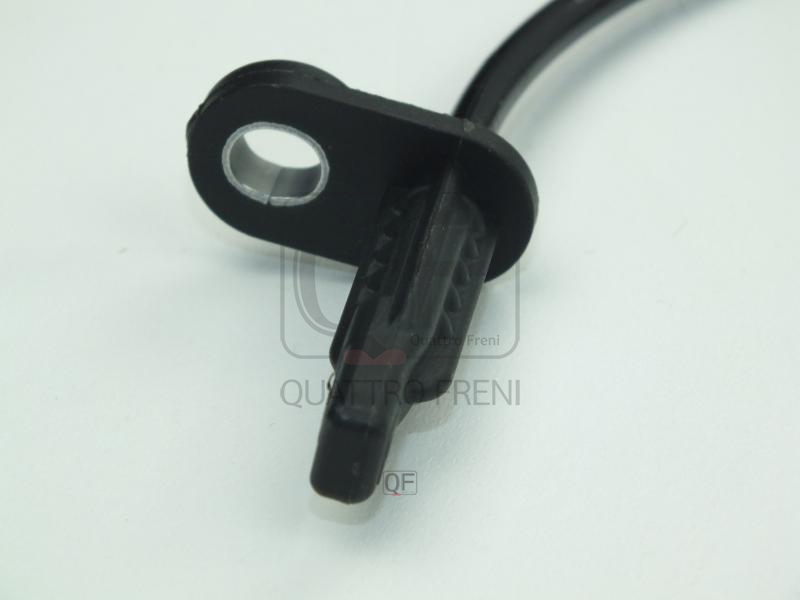
Active ABS sensor with integrated wiring harness and connector - direct plug-and-play replacement. View in catalog
Active sensors contain a semiconductor chip (Hall-effect or magnetoresistive element) that is powered by the ABS control module through the wiring harness. The chip detects changes in magnetic field as the reluctor ring rotates and outputs a clean digital square wave signal.
Key characteristics of active sensors: they require power from the ECU (typically 5V or 12V supply), the output is a digital square wave with consistent amplitude regardless of speed, they can detect wheel speed all the way down to near-zero (critical for hill-start assist and parking functions), they typically have two or three wires (power, signal, and sometimes a separate ground), and they use a magnetic encoder ring - often a multipole rubber ring pressed into the wheel bearing inner seal.
Active sensors are standard on virtually all passenger vehicles manufactured from 2005 onward. They are smaller, more accurate, and support the advanced driver assistance features that modern vehicles require.
Why This Matters for Sourcing
A passive sensor and an active sensor for the same vehicle position are NOT interchangeable. They use different reluctor rings, different signal types, and different wiring. Confirming the correct sensor type by OEM part number - not just by vehicle application - is essential when sourcing wholesale quantities. The ok.parts catalog specifies the exact OEM cross-reference for every sensor SKU, eliminating fitment guesswork.
3. Failure Symptoms and Diagnostic Trouble Codes
ABS sensor failures are among the most common reasons for dashboard warning lights in vehicles over 5 years old. Recognizing the symptoms helps distributors advise their customers and ensures correct replacement part selection.
Common Failure Symptoms
ABS warning light illuminated. The most obvious symptom. The ABS module detects missing or erratic signal from one or more sensors and disables the anti-lock function. Brakes still work normally but without ABS intervention during hard braking.
Traction control and stability control lights active. Because TCS and ESC/ESP share the same wheel speed data, a single sensor failure typically triggers all three warning lights simultaneously. This is often the first sign noticed by the driver.
ABS activating at low speed on dry roads. An intermittent or noisy sensor signal can cause the ABS module to incorrectly detect wheel lock-up during normal braking. The driver feels a pulsation in the brake pedal at low speeds when it should not be present.
Speedometer malfunction. On vehicles where the speedometer derives its signal from ABS wheel speed data (common in modern cars), a failed sensor can cause erratic or zero speedometer readings.
Cruise control disabled. Adaptive and conventional cruise control systems require accurate wheel speed data. A sensor fault will prevent cruise control engagement.
Common Diagnostic Trouble Codes (DTCs)
| DTC Code | Description | Typical Cause |
|---|---|---|
| C0035-C0038 | Left front / right front / left rear / right rear wheel speed sensor circuit | Open or short circuit in sensor wiring, failed sensor element |
| C0040-C0043 | Left front / right front / left rear / right rear wheel speed sensor signal | Erratic or missing signal - damaged reluctor ring, excessive air gap, debris contamination |
| C0045-C0050 | Wheel speed sensor signal erratic or intermittent | Partially damaged wiring harness, corroded connector, cracked reluctor ring |
| C0060-C0063 | Wheel speed sensor bias (stuck high or low) | Internal sensor failure, metallic debris on sensor face |
| U0121-U0124 | Lost communication with ABS module | ABS module fault or CAN bus wiring - not always sensor related |
Note: DTC numbering varies by manufacturer. VAG group uses codes in the 16xxx-16xxx range, Toyota uses C1xxx, BMW uses 5Exxx. Always cross-reference with manufacturer-specific code tables.
4. Common Failure Causes and What to Inspect
ABS sensors fail gradually rather than suddenly. Understanding failure mechanisms helps distributors advise customers on related parts and helps mechanics avoid repeat repairs.
Cable chafing and breakage. The sensor wiring harness runs from the wheel area through the suspension and into the body. Steering movement, suspension travel, and road debris all stress the cable. The most common failure point is where the harness flexes near the steering knuckle. Look for abraded insulation, kinked wires, or corroded breakpoints.
Connector corrosion. The sensor connector is located in the wheel well area and exposed to water, road salt, and mud. Over time, pins corrode and contact resistance increases, degrading the signal. In severe cases the connector seizes and breaks during disconnection. Always inspect the connector and apply dielectric grease during replacement.
Sensing face contamination. Metallic debris from worn brake components (pad dust, rotor particles) accumulates on the magnetic sensing face. This alters the air gap and can cause erratic signals. Cleaning the sensor face is a first diagnostic step before replacement.
Reluctor ring damage. The toothed ring that the sensor reads can crack, lose teeth (pressed steel type), or delaminate (magnetic encoder type). A damaged reluctor ring produces erratic signals even with a new sensor. Always inspect the reluctor ring before installing a replacement sensor - this is the single most common cause of "new sensor still throws a code" callbacks.
Bearing-integrated encoder ring failure. On modern vehicles with active sensors, the magnetic encoder ring is pressed into the wheel bearing seal. When the bearing is replaced, the encoder ring must be preserved or replaced along with it. Damaged or missing encoder rings are a frequent cause of ABS faults after bearing replacement.
5. OEM Cross-Reference Guide by Vehicle Brand
ABS sensors are highly vehicle-specific. Each sensor has a unique OEM part number defined by the vehicle manufacturer. Below are examples of common OEM numbers by brand - all available in the ok.parts wholesale catalog.
European Vehicles
| Brand | Example OEM Numbers | Common Applications |
|---|---|---|
| VAG (VW/Audi/Skoda/Seat) | WHT003856, 6Q0927807B, 1K0927808 | Golf, Passat, Tiguan, A3, A4, Octavia, Leon |
| BMW / Mini | 34526762465, 34526870076, 34526869320 | 3 Series, 5 Series, X3, X5 |
| Mercedes-Benz | A2049052905, A1645400717, A2215400117 | C-Class, E-Class, ML/GLE, S-Class |
| Renault | 479005846R, 8200583498, 479109377R | Clio, Megane, Scenic, Duster |
| Peugeot/Citroen | 4545G6, 4545A9, 9805066080 | 308, 3008, C4, C5, Berlingo |
| Volvo | 21663559, 30773738, 31423382 | XC60, XC90, V60, S80 |
Japanese and Korean Vehicles
| Brand | Example OEM Numbers | Common Applications |
|---|---|---|
| Toyota/Lexus | 8954333070, 8954560030, 8954248040 | Camry, Corolla, RAV4, Land Cruiser, RX |
| Honda | 57455SNAA01, 57470SNAA01, 57475SEA013 | Civic, Accord, CR-V, HR-V |
| Nissan | 47910EA025, 47911CA000, 47900JA00A | Qashqai, X-Trail, Navara, Pathfinder |
| Hyundai/Kia | 956701R000, 599103N500, 956803X300 | Tucson, Sportage, Creta, Rio, Cerato |
| Mazda | BJ0E4373XA, GS1D4370XB, L20643712 | CX-5, Mazda 3, Mazda 6 |
American and Chinese Vehicles
| Brand | Example OEM Numbers | Common Applications |
|---|---|---|
| General Motors | 15229012, 20938121, 22739727 | Silverado, Equinox, Malibu, Cruze |
| Ford | AV612B372BB, BK212B372AB, DG1Z2C190A | Focus, Escape, F-150, Transit |
| Great Wall | 3550140XKZ16A, 3550120K80, 3550150P64 | Haval H6, H9, Poer/Cannon |
| Geely | 1067001244, 1017009588, 4010016300 | Coolray, Atlas, Emgrand |
This is a small sample. The complete ABS sensor catalog on ok.parts contains thousands of SKUs covering European, Japanese, Korean, American, and Chinese vehicle brands - all searchable by OEM number.
6. Why ABS Sensors Are a High-Margin Wholesale Opportunity
ABS sensors are one of the most attractive product categories for auto parts importers and distributors. Here is why:
Universal demand. Every vehicle on the road has 2-4 ABS sensors. With a global vehicle fleet exceeding 1.4 billion vehicles, and sensors that typically fail between 80,000-150,000 km, the replacement market is enormous and continuous.
High unit margin. Wholesale pricing from Chinese factories typically ranges from $2-$8 per unit. Aftermarket retail pricing runs $15-$60. Even at wholesale distributor pricing of $10-$25, margins of 50-70% are standard.
Low weight, high value. ABS sensors are small and light (typically 50-200 grams). This means low shipping cost per unit, more units per container, and favorable economics even for air freight.
Technical barrier to entry. Unlike commodity parts like oil filters, ABS sensors require correct OEM cross-referencing, connector matching, and signal type verification. Distributors who provide accurate technical data and reliable quality earn customer loyalty. This is not a category where buyers switch suppliers over a 5% price difference.
Growing complexity. Modern vehicles have more electronic safety systems than ever, all dependent on wheel speed data. As vehicle fleets age, the installed base of sensors approaching end-of-life grows every year.
7. Sourcing ABS Sensors Wholesale from China
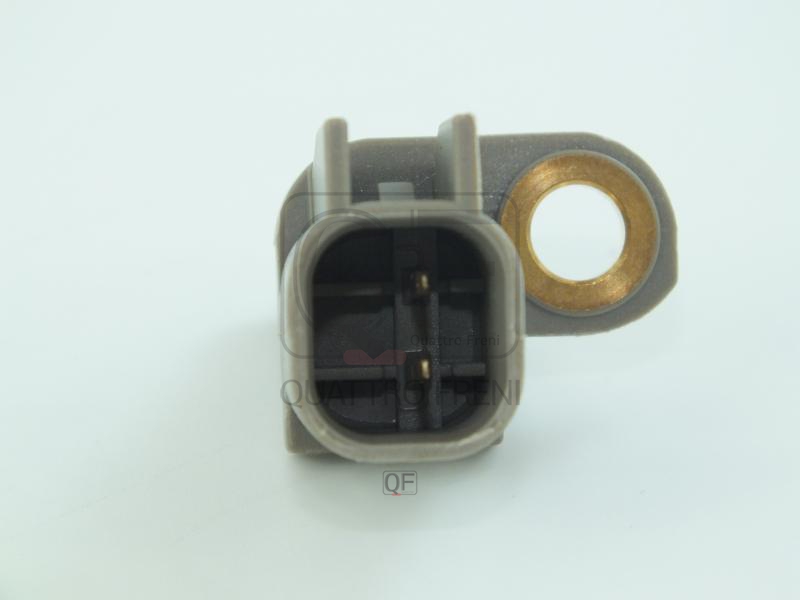
Close-up of an ABS sensor showing the connector interface and mounting geometry - critical dimensions for OEM-equivalent matching.
China is the world's largest manufacturer of aftermarket ABS sensors. The key manufacturing clusters are in Ruian (Zhejiang) and Guangzhou (Guangdong), where dozens of specialized factories produce sensors for the global aftermarket.
What to Verify When Sourcing
Signal type and output. The aftermarket sensor must produce the same signal type (analog AC for passive, digital square wave for active) as the OEM part. Signal amplitude and frequency characteristics must match.
Connector pinout and weatherproofing. The connector must be an exact match - same pin arrangement, same locking mechanism, same weatherproof seal rating. A connector that "almost fits" will create intermittent faults that are extremely difficult to diagnose.
Air gap tolerance. The sensor must maintain correct air gap to the reluctor ring. This is determined by the sensor housing geometry and mounting surface. Dimensional accuracy of the mounting bracket and sensor body is critical.
Cable length and routing. The wiring harness length must match the OEM part to ensure proper routing through the vehicle suspension and body. Too short creates stress during suspension travel; too long creates interference risk.
Operating temperature range. Sensors mounted near brake components experience extreme temperatures. The sensor must be rated for the full operating range, typically -40C to +150C for brake-adjacent mounting positions.
Quality Control for ABS Sensors
ABS sensors require stricter quality control than many other part categories because they are electronic components in a safety-critical system. The ok.parts 3-stage QC process includes specific checks for sensors: oscilloscope testing of signal output waveform, connector pin-out verification against OEM wiring diagrams, air gap dimensional measurement, cable pull-test for harness retention, and weatherproof seal integrity check.
8. ABS Sensor Installation Best Practices
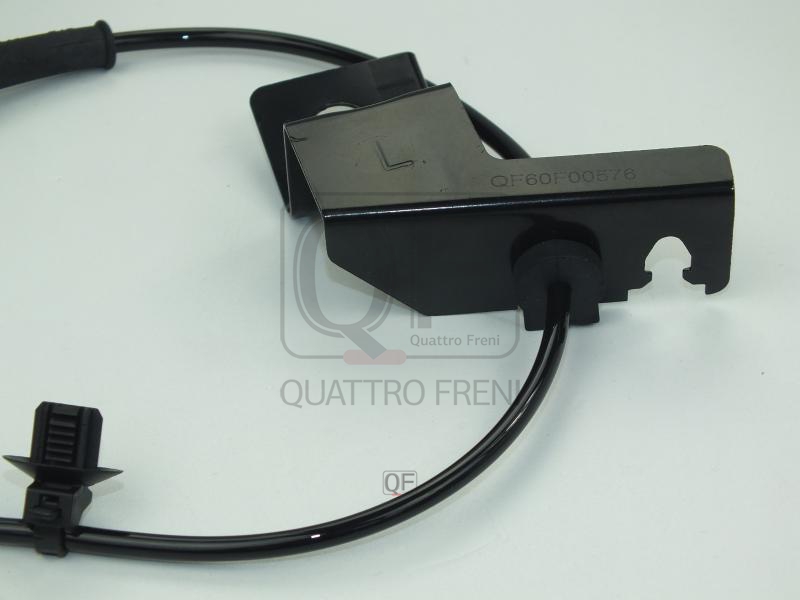
ABS sensor with full wiring harness - verify cable length and connector type match OEM specifications before installation.
This section helps distributors provide technical guidance to their workshop customers, reducing warranty claims and building trust.
Always inspect the reluctor ring first. Before installing a new sensor, inspect the tone ring for cracks, missing teeth, rust buildup, or delamination. A damaged reluctor ring will cause ABS faults with any sensor. On vehicles with bearing-integrated encoder rings, confirm the ring is present and undamaged.
Clean the mounting surface. Remove any corrosion, rust, or debris from the sensor mounting bore in the steering knuckle or hub carrier. The sensor must seat fully and consistently to maintain correct air gap.
Apply anti-seize to the mounting bore. A thin coat of copper anti-seize on the sensor body prevents future corrosion seizure. Do not apply to the sensing face.
Apply dielectric grease to the connector. Before plugging in the new sensor, apply dielectric grease to the connector pins. This prevents future corrosion - the most common cause of premature sensor failure in road-salt environments.
Route the harness correctly. Follow the OEM harness routing exactly. The cable must not contact moving suspension components, and must have sufficient slack for full suspension travel and steering lock-to-lock movement. Secure with OEM-style clips.
Clear codes and road test. After installation, clear stored ABS, TCS, and ESC fault codes using an OBD-II scanner. Perform a road test above 30 km/h to allow the ABS module to verify consistent signals from all four corners. The system validates automatically.
9. Frequently Asked Questions
What is an ABS wheel speed sensor?
An ABS wheel speed sensor is a magnetic or Hall-effect device mounted at each wheel hub or knuckle. It monitors the rotational speed of the wheel and sends a pulse signal to the ABS control module, traction control system, and electronic stability control. Each modern vehicle has four sensors - one per wheel.
What are the symptoms of a bad ABS sensor?
The most common symptoms are: ABS warning light on the dashboard, traction control and stability control warning lights active simultaneously, ABS activating unexpectedly at low speeds on dry roads, erratic or zero speedometer reading, and cruise control not engaging. Diagnostic codes C0035-C0050 or manufacturer-specific equivalents will identify the affected wheel.
What is the difference between active and passive ABS sensors?
Passive sensors generate their own signal using a magnetic coil - they produce an AC voltage that increases with speed and cannot detect speed below about 5 km/h. Active sensors use a Hall-effect chip powered by the ECU and output a clean digital signal at all speeds including near-zero. Most vehicles from 2005 onward use active sensors. The two types are not interchangeable.
How much do wholesale ABS sensors from China cost?
Wholesale pricing from verified Chinese factories typically ranges from $2-$8 per unit depending on sensor type (passive vs. active), connector complexity, and order volume. Aftermarket retail pricing runs $15-$60, making this one of the highest-margin sensor categories for distributors.
Can Chinese aftermarket ABS sensors replace OEM parts?
Yes. OEM-equivalent ABS sensors from verified factories match the original specifications: signal output waveform, air gap tolerance, connector pinout, operating temperature range, and cable length. They are direct plug-and-play replacements requiring no ECU recalibration. Quality verification through 3-stage quality control is essential to ensure consistency.
How do I find the correct ABS sensor for a specific vehicle?
Search by OEM part number - this is the most reliable method. The OEM number is printed on the original sensor or listed in the vehicle manufacturer's parts catalog. The ok.parts ABS sensor catalog is searchable by OEM number and shows all matching aftermarket equivalents with cross-references, specifications, and wholesale pricing.
Do ABS sensors need calibration after replacement?
No. Standard ABS wheel speed sensor replacement does not require calibration or ECU coding. After installation, clear stored fault codes with an OBD-II scanner and perform a short road test above 30 km/h. The ABS module self-validates automatically. The only exception is some BMW and Mercedes models that require a brief initialization procedure through the diagnostic interface.