95560612930 Oxygen Sensor - Porsche Cayenne, VW Golf, Audi A3 | Wholesale
Complete technical guide for the 95560612930 oxygen sensor (lambda sensor) - covering vehicle fitment, cross-references, specifications, failure diagnostics, installation procedure, and wholesale sourcing from China.
The VAG 95560612930 is a wideband oxygen sensor (Bosch LSU 4.9 type) originally specified for the Porsche Cayenne 955/957 3.6L V6 in the upstream pre-catalyst position. Through the VAG Group parts-sharing system, this sensor cross-references to 14 different OEM numbers covering Porsche, Volkswagen, Audi, Skoda, Seat, Mercedes-Benz, Land Rover, and Ford applications - making it one of the most widely applicable oxygen sensors in the European aftermarket.
With 834 units sold through the ok.parts catalog at a wholesale price of $15.85 per unit, this is a proven high-demand SKU for distributors serving the European vehicle aftermarket.
- Product Specifications and Technical Data
- Vehicle Fitment and Application Guide
- Complete OEM Cross-Reference Table
- How This Sensor Works - Wideband LSU 4.9 Technology
- Failure Symptoms and Diagnostic Codes
- Step-by-Step Diagnostic Procedure
- Installation Guide and Torque Specs
- Frequently Replaced Together
- Wholesale Sourcing and Pricing
- Frequently Asked Questions
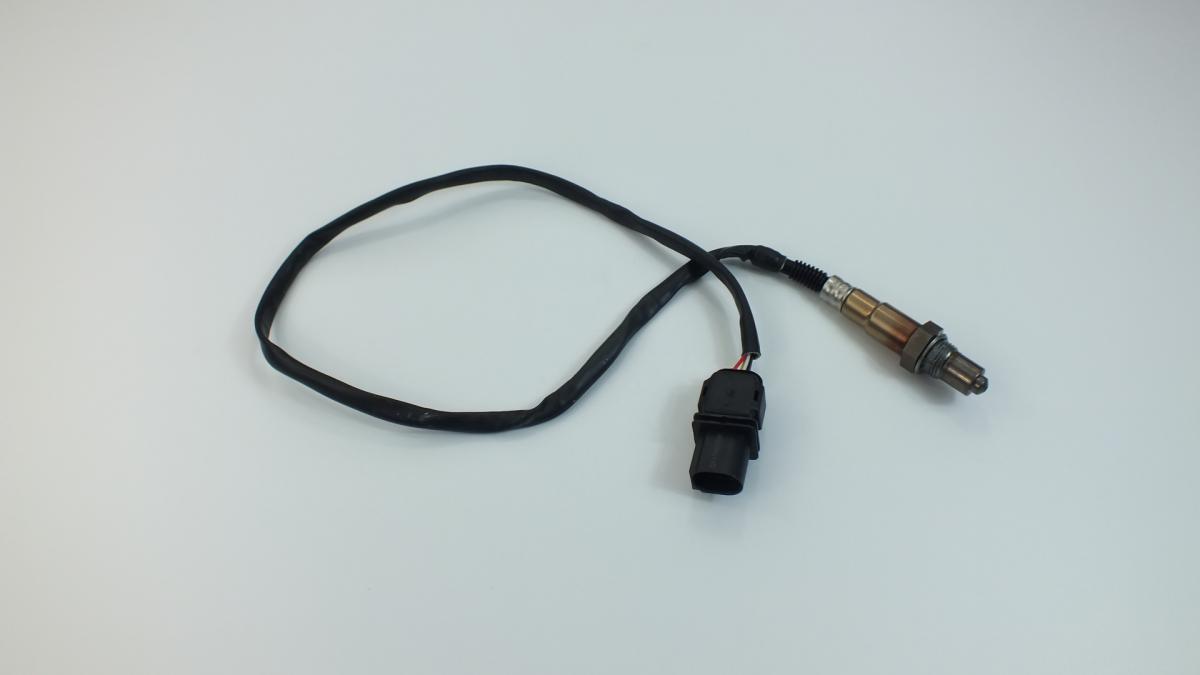
VAG 95560612930 wideband oxygen sensor - upstream pre-catalyst, OEM-equivalent quality. View full product page
1. Product Specifications and Technical Data
| Primary OEM Number | 95560612930 (VAG / Porsche) |
| Key Cross-References | 03C906262A (VAG), 1K0998262L (VAG), A1715400617 (Mercedes-Benz) |
| Bosch Reference | 0 258 017 178 / 0 258 017 179 (LSU 4.9) |
| Sensor Type | Wideband (air-fuel ratio sensor), planar ZrO2 element |
| Position | Upstream (pre-catalytic converter) |
| Thread Size | M18 x 1.5 |
| Wire Count | 5 wires (heater +, heater -, pump current, reference, signal ground) |
| Heater Resistance | 2-4 ohms at 20C (verify with multimeter before installation) |
| Operating Temperature | Sensor element: 650-900C; housing: up to 150C |
| Net Weight | 0.13 kg |
| HS Code | 9026.80 (verify subheading with customs broker) |
| Country of Manufacture | China |
| Quality Grade | OEM Equivalent |
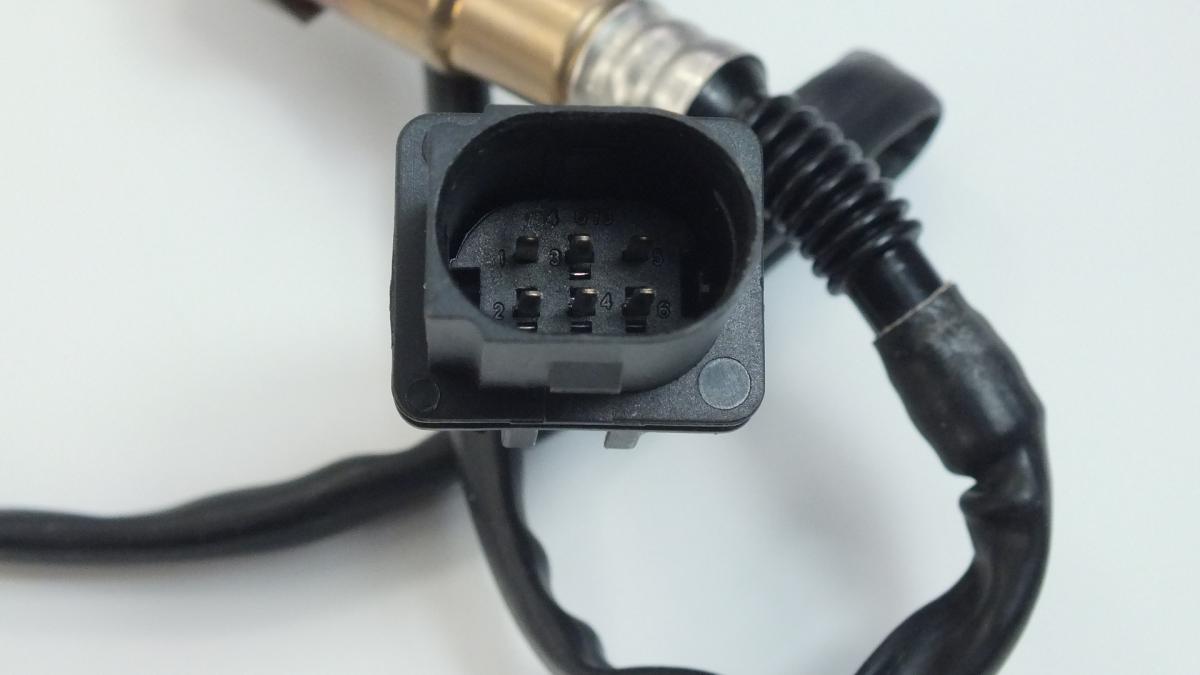
Side view showing the 5-pin connector and wiring harness configuration.
2. Vehicle Fitment and Application Guide
The 95560612930 and its cross-references cover an extremely wide range of European vehicles. This is because the Bosch LSU 4.9 wideband sensor platform is used across multiple manufacturer groups with different OEM part numbers for the same physical sensor.
Porsche (Primary Application)
| Model | Engine | Years | Position |
|---|---|---|---|
| Cayenne (955) | 3.6L V6 (M55.01) | 2007-2010 | Upstream, Bank 2 (Cyl 4-6) |
| Cayenne (957) | 3.6L V6 (M55.02) | 2007-2010 | Upstream, Bank 2 (Cyl 4-6) |
Volkswagen / Audi / Skoda / Seat (via 03C906262A / 1K0998262L)
| Model | Engine | Years | Position |
|---|---|---|---|
| VW Golf V / VI | 1.4 TSI, 1.6 FSI | 2003-2013 | Upstream, pre-catalyst |
| VW Passat B6 / B7 | 1.4 TSI, 1.6 FSI, 2.0 TFSI | 2005-2014 | Upstream, pre-catalyst |
| VW Tiguan (5N) | 1.4 TSI, 2.0 TFSI | 2007-2016 | Upstream, pre-catalyst |
| Audi A3 (8P) | 1.4 TFSI, 1.6 FSI, 2.0 TFSI | 2004-2013 | Upstream, pre-catalyst |
| Audi A4 (B7/B8) | 1.8 TFSI, 2.0 TFSI | 2004-2015 | Upstream, pre-catalyst |
| Skoda Octavia II / III | 1.4 TSI, 1.6 FSI | 2004-2017 | Upstream, pre-catalyst |
| Seat Leon II (1P) | 1.4 TSI, 1.6 FSI | 2005-2012 | Upstream, pre-catalyst |
Mercedes-Benz (via A1715400617)
| Model | Engine | Years | Position |
|---|---|---|---|
| C-Class (W204) | C180/C200 CGI (M271) | 2007-2014 | Upstream, pre-catalyst |
| E-Class (W212) | E200/E250 CGI (M271) | 2009-2016 | Upstream, pre-catalyst |
| SLK (R171) | SLK200 Kompressor (M271) | 2004-2011 | Upstream, pre-catalyst |
Land Rover and Ford
Through cross-reference LR001370 (Land Rover) and 1688499 (Ford), this sensor also fits select Land Rover Freelander and Ford Focus/Mondeo applications with compatible Bosch engine management systems. Always verify the exact application by matching the OEM number from the vehicle's parts catalog.
3. Complete OEM Cross-Reference Table
The following 14 OEM numbers all reference the same physical sensor. When searching for stock or ordering replacements, any of these numbers will match this unit:
| Brand | OEM Number | Notes |
|---|---|---|
| VAG / Porsche | 95560612930VAG 95560612930 | Primary Porsche Cayenne number |
| VAG | 03C906262AVAG 03C906262A | VW/Audi/Skoda/Seat primary number - highest search volume |
| VAG | 03C906262BJ | Superseded revision of 03C906262A |
| VAG | 1K0998262L | Service kit number (sensor + connector) |
| Mercedes-Benz | A1715400617 | Mercedes primary number - W204 C-Class, W212 E-Class |
| Mercedes-Benz | 1715400617 | Same as above without "A" prefix |
| Mercedes-Benz | 715400617 | Short format without prefix |
| Mercedes-Benz | A14752000 | Alternative Mercedes catalog number |
| Mercedes-Benz | A211540170011 | E-Class specific catalog reference |
| Mercedes-Benz | A54035134 | SLK/CLK specific reference |
| Mercedes-Benz | BZS8800176 | Mercedes aftermarket service number |
| Land Rover | LR001370 | Freelander 2 application |
| Ford | 1688499 | Ford Europe catalog number |
| MILES (aftermarket) | EFBS010 | Aftermarket brand cross-reference |
All 14 numbers are searchable in the ok.parts catalog. For distributors, stocking this single SKU covers demand from Porsche, VW, Audi, Skoda, Seat, Mercedes-Benz, Land Rover, and Ford customers.
4. How This Sensor Works - Wideband LSU 4.9 Technology
The 95560612930 is a Bosch LSU 4.9 wideband (air-fuel ratio) sensor - not a simple narrowband switching sensor. Understanding this distinction is critical because wideband and narrowband sensors are not interchangeable and produce fundamentally different signals.
A wideband sensor uses a dual-cell design: a Nernst concentration cell (similar to a narrowband sensor) combined with an oxygen pumping cell, both controlled by a dedicated IC. The ECU applies a current to the pumping cell to maintain the Nernst cell at exactly lambda = 1. The amount and direction of pumping current required to maintain this balance is proportional to the actual air-fuel ratio. This allows the ECU to measure the exact AFR - not just whether the mixture is rich or lean.
The 5-wire configuration carries: heater positive, heater negative (for rapid warm-up to 650C operating temperature), pump current (the measurement signal), reference cell voltage, and signal ground. The sensor reaches operating temperature in approximately 10-20 seconds thanks to the integrated ceramic heater element, enabling closed-loop fuel control almost immediately after engine start.
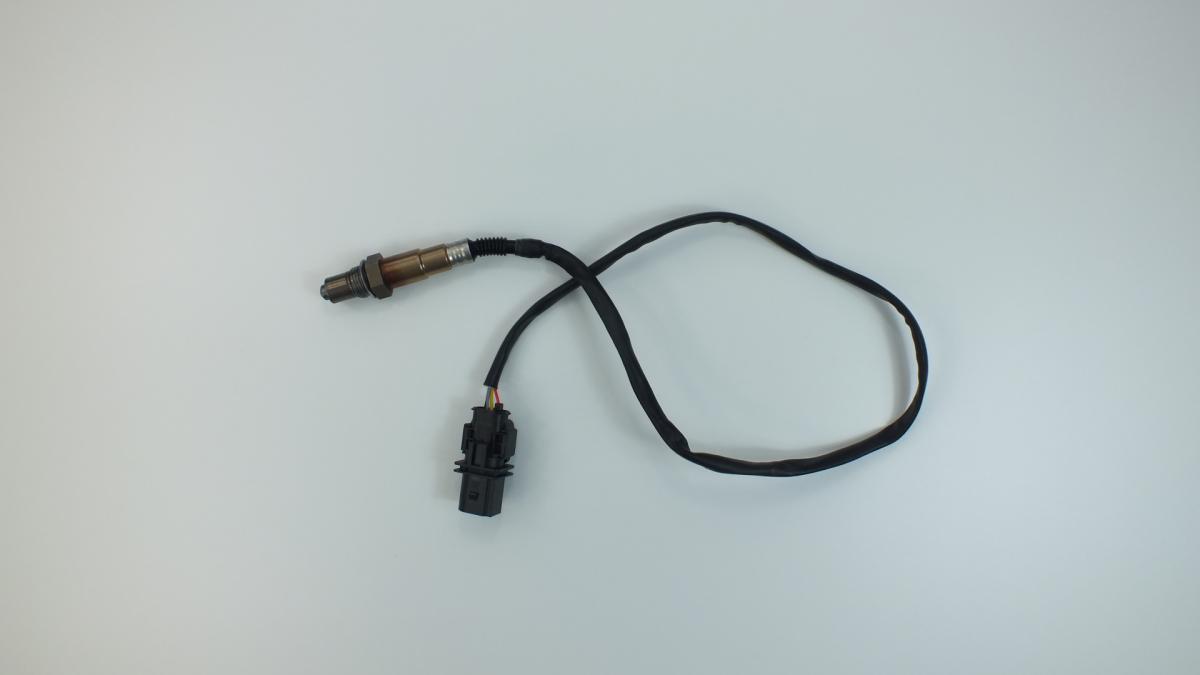
Detail view showing the M18x1.5 thread and protective sensor tip housing the planar sensing element.
This wideband technology is why the sensor is used across such a wide range of vehicles - the LSU 4.9 platform is a Bosch standard design adopted by multiple vehicle manufacturers. The physical sensor is identical; only the OEM part number and packaging differ between Porsche, VW, Mercedes, and other applications.
5. Failure Symptoms and Diagnostic Codes
When this sensor fails, the effects are immediate and measurable:
Check engine light with codes P0130-P0167. The specific code identifies the fault type: P0130 (circuit malfunction), P0131 (low voltage), P0132 (high voltage), P0133 (slow response), P0134 (no activity), P0135 (heater circuit). On Porsche Cayenne, the factory PIWIS system may report Porsche-specific codes in the P1xxx range.
Increased fuel consumption of 10-20%. Without accurate wideband feedback, the ECU falls back to open-loop fuel maps that are deliberately rich to protect the catalytic converter. This rich running wastes fuel continuously.
Rough idle and hesitation. The ECU cannot trim fuel delivery accurately without the sensor's precise AFR data. The air-fuel mixture oscillates outside the optimal window, causing uneven combustion.
Failed emissions test. A rich-running condition dramatically increases HC (hydrocarbon) and CO (carbon monoxide) emissions. Additionally, if the downstream sensor is also affected, a P0420/P0430 catalyst efficiency code will fail the vehicle on OBD-II readiness checks.
Catalytic converter damage. Sustained rich running sends unburned fuel into the catalytic converter, overheating the ceramic substrate. This is the most expensive consequence of ignoring a failed upstream oxygen sensor - a catalytic converter replacement on a Porsche Cayenne costs 10-20 times more than the sensor itself.
Scan tool live data confirmation: On a healthy wideband sensor, the scan tool shows a stable lambda value of approximately 1.00 at warm idle, fluctuating slightly as the ECU makes minor corrections. A failed sensor shows a fixed reading, erratic jumping, or no data at all.
6. Step-by-Step Diagnostic Procedure
Step 1: Connect an OBD-II scanner and read stored and pending fault codes. Note the specific code number and which sensor position it identifies (Bank 1 Sensor 1, Bank 2 Sensor 1, etc.).
Step 2: View live data for the affected oxygen sensor. On a wideband sensor, the scan tool should show lambda or AFR values. A healthy sensor at warm idle displays a stable value near 1.00 (lambda) or 14.7 (AFR). A reading that is fixed, erratic, or reads 0.00 confirms sensor failure.
Step 3: Check the heater circuit. With the ignition on and engine off, measure heater resistance across the heater pins at the sensor connector (disconnect the sensor first). Expected resistance: 2-4 ohms at room temperature. An open circuit (infinite resistance) confirms a burned-out heater element.
Step 4: Inspect the wiring harness and connector. Look for corroded pins, melted insulation from contact with the exhaust, or chafed wires. A wiring fault can mimic a sensor failure - repair the wiring before condemning the sensor.
Step 5: Check for contamination sources. If the sensor is less than 80,000 km old, investigate why it failed prematurely: check for oil burning (blue smoke at startup), coolant leaks into combustion (white smoke, sweet smell), or incorrect RTV sealant used during recent engine work (silicone contamination).
Step 6: If the sensor is confirmed faulty, replace with the 95560612930 OEM-equivalent unit and follow the installation procedure below.
7. Installation Guide and Torque Specs
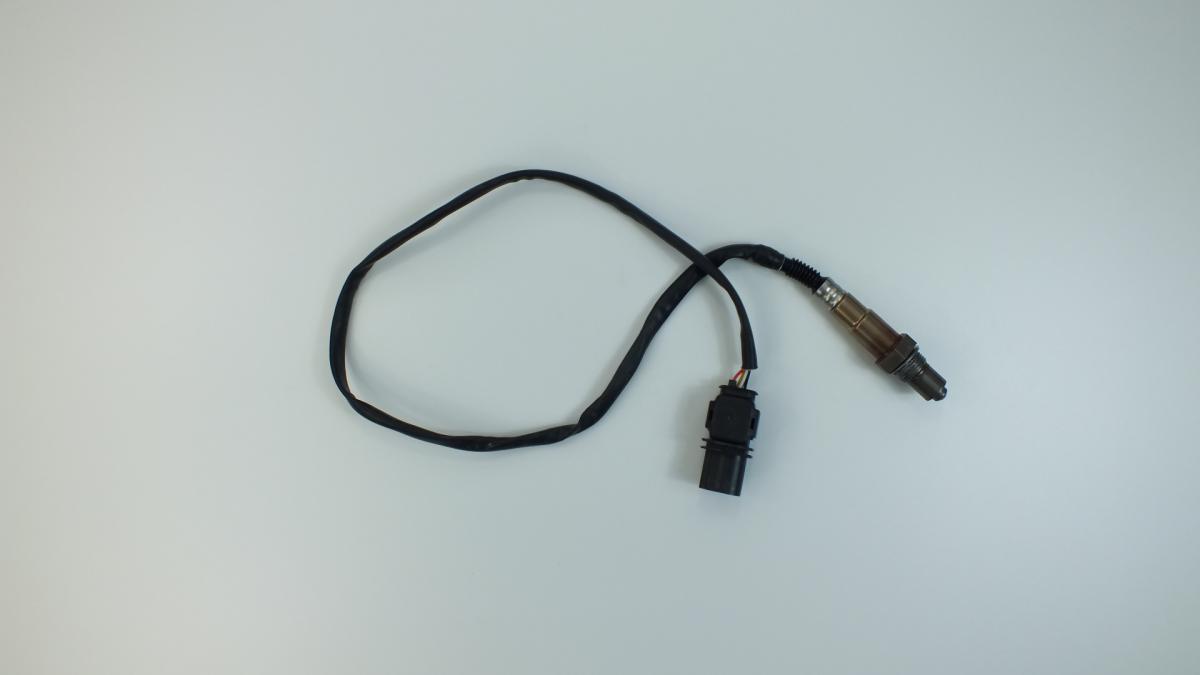
Thread and protective cap detail - remove cap before installation, apply anti-seize to threads only.
1. Allow exhaust to cool completely. Oxygen sensor threads seize in hot exhaust bosses. Apply penetrating oil and soak for 20 minutes before removal if corroded.
2. Use a 22mm oxygen sensor socket with a side slot for the wiring harness. Never use an open-end wrench - rounding the hex requires cutting the sensor out.
3. Inspect the thread boss in the exhaust pipe after removing the old sensor. Clean with an M18x1.5 thread chaser if damaged. A stripped boss requires a thread insert repair.
4. Apply nickel-based anti-seize sparingly to the new sensor threads only. Keep the last two threads and the sensor tip completely clean - any compound on the sensing element causes immediate failure.
5. Torque to 40-55 Nm (consult vehicle-specific manual for exact value). Over-torquing crushes the sensor body; under-torquing causes exhaust leaks that produce false lean readings.
6. Route the wiring harness away from exhaust components and secure with original clips. A harness resting on the exhaust pipe will melt within minutes of engine startup.
7. Clear codes and verify. Start the engine, let it reach operating temperature. Use a scan tool to clear all stored DTCs and verify the sensor is producing a stable lambda reading near 1.00 at idle. Drive the vehicle through a complete drive cycle (idle, cruise, acceleration, deceleration) and confirm no new codes appear.
Tools required: OBD-II scanner with live O2 data, 22mm oxygen sensor socket, torque wrench, penetrating oil, M18x1.5 thread chaser, nickel-based anti-seize.
8. Frequently Replaced Together
| Part | Why Replace Together |
|---|---|
| Catalytic Converter | A failed upstream sensor causing rich running damages the converter. If P0420/P0430 codes are present alongside sensor codes, the converter may need replacement. Always replace the sensor first and recheck converter codes after a drive cycle. |
| Spark Plugs | Rich running from a failed sensor fouls spark plugs with carbon. If plugs are heavily fouled, replace simultaneously to prevent misfire codes after the new sensor restores correct fuelling. |
| Exhaust Manifold Gasket | An exhaust leak upstream of the sensor introduces ambient air, causing false lean readings. If a leak is found during sensor removal, replace the gasket before fitting the new sensor. |
| Downstream O2 Sensor | On vehicles above 150,000 km where the upstream sensor has failed from age, the downstream sensor has the same mileage and may be approaching failure. Inspect live data and replace if switching frequency is slow. |
9. Wholesale Sourcing and Pricing
The 95560612930 is available through ok.parts at wholesale pricing with full 3-stage quality control:
| Wholesale Price (USD) | $15.85 per unit |
| Wholesale Price (CNY) | 108 CNY per unit |
| Minimum Order Quantity | 10 pieces |
| Production Lead Time | 25 days |
| Shipping | DDP worldwide, FOB, or CIF available |
| Quality Control | 3-stage: pre-production, in-process, pre-shipment (heater resistance + signal verified) |
| Packaging | Standard neutral or custom private label available |
| Units Sold | 834 (proven demand) |
For distributors, the cross-reference coverage makes this a strategic SKU: one inventory item covers demand from Porsche, VW, Audi, Skoda, Seat, Mercedes, Land Rover, and Ford workshops. At $15.85 wholesale vs. $80-$150 retail pricing for branded equivalents (Bosch, NTK, Denso), the margin opportunity is substantial.
10. Frequently Asked Questions
What vehicles does the 95560612930 oxygen sensor fit?
Primary application is Porsche Cayenne 955/957 3.6L V6 (2005-2010), upstream pre-catalyst. Through 14 cross-references, it also fits VW Golf V/VI, Passat B6/B7, Tiguan, Audi A3/A4, Skoda Octavia, Seat Leon (via 03C906262A/1K0998262L), Mercedes-Benz C-Class W204 and E-Class W212 (via A1715400617), Land Rover Freelander (via LR001370), and select Ford applications (via 1688499).
Is the 95560612930 a narrowband or wideband sensor?
It is a wideband sensor (Bosch LSU 4.9 type) with 5 wires. It produces a linear current output proportional to the exact air-fuel ratio, not just a rich/lean switching signal. Wideband sensors are NOT interchangeable with narrowband sensors - always verify the correct type for your application.
What are the most important cross-references for this sensor?
03C906262A is the highest-volume VAG number (Golf, A3, Octavia). A1715400617 covers Mercedes applications. 1K0998262L is the VAG service kit number. All 14 cross-references are the same physical sensor with different manufacturer catalog numbers.
What diagnostic codes indicate this sensor needs replacement?
P0130 (circuit malfunction), P0131 (low voltage), P0132 (high voltage), P0133 (slow response), P0134 (no activity), and P0135 (heater circuit failure). On Bank 2 positions, the equivalent codes are P0150-P0155. Always verify with live scan tool data showing the sensor's actual output before replacing.
Does this sensor require adaptation or coding after installation?
No ECU coding or adaptation is required for oxygen sensor replacement. Clear all stored fault codes with an OBD-II scanner after installation and perform a complete drive cycle. The ECU's long-term fuel trim values will self-correct within 1-2 drive cycles once the new sensor provides accurate feedback.
Can I use this sensor as a downstream (post-catalyst) replacement?
This sensor is specified for the upstream (pre-catalyst) position. Downstream positions on many of these vehicles use a simpler narrowband sensor with a different connector and fewer wires. Do not substitute a wideband upstream sensor for a narrowband downstream sensor - they produce different signal types and will trigger fault codes.
Why is this sensor so much cheaper than Bosch or NTK branded equivalents?
The sensor is manufactured in China to OEM-equivalent specifications using the same Bosch LSU 4.9 technology platform. The price difference reflects direct factory sourcing without brand licensing fees, European distribution markups, or retail overhead. 3-stage quality control ensures the sensor meets OEM specifications for heater resistance, signal output, and dimensional accuracy.
Related Guides
- Oxygen Sensors (Lambda Sensors): Complete Technical and Wholesale Guide
- Ignition Coils: Complete Technical and Wholesale Guide
- ABS Wheel Speed Sensors: Complete Technical and Wholesale Guide
- How to Source OEM-Quality Auto Parts from China
- Wholesale Auto Parts Supplier from China
- Auto Parts Quality Control in China